

| Calcium RDA increase after 50 (women) | 1,000 mg → 1,200 mg/day (NIH Office of Dietary Supplements) |
| Vitamin D RDA after age 70 | 800 IU/day (NIH Office of Dietary Supplements) |
| Iron RDA drop for women post-menopause | 18 mg → 8 mg/day (NIH Office of Dietary Supplements) |
| B12 RDA across most of adulthood | 2.4 mcg/day (NIH Office of Dietary Supplements) |
| Adults over 50 advised to get B12 from | Fortified foods or supplements (NIH — due to reduced stomach acid affecting food-bound B12 absorption) |
| Folate need during early pregnancy | 600 mcg DFE/day (NIH Office of Dietary Supplements) |
Why Nutrient Needs Don't Stay Fixed
Most people assume their vitamin and mineral requirements are stable once they reach adulthood. In reality, the body's demand for specific micronutrients rises and falls across decades in response to hormonal changes, shifts in absorption efficiency, bone remodeling, immune function, and lifestyle factors. The National Institutes of Health (NIH) establishes DRIs—a set of reference values updated periodically to reflect this life-stage variation.
Understanding where your current life stage falls on that spectrum is a practical first step toward filling potential gaps. As a complement to this, how macronutrient needs evolve across life stages is equally worth reviewing, since micronutrient and macronutrient changes often go hand in hand.
| Calcium RDA increase after 50 (women) | 1,000 mg → 1,200 mg/day (NIH Office of Dietary Supplements) |
| Vitamin D RDA after age 70 | 800 IU/day (NIH Office of Dietary Supplements) |
| Iron RDA drop for women post-menopause | 18 mg → 8 mg/day (NIH Office of Dietary Supplements) |
| B12 RDA across most of adulthood | 2.4 mcg/day (NIH Office of Dietary Supplements) |
| Adults over 50 advised to get B12 from | Fortified foods or supplements (NIH — due to reduced stomach acid affecting food-bound B12 absorption) |
| Folate need during early pregnancy | 600 mcg DFE/day (NIH Office of Dietary Supplements) |
Key Micronutrients That Shift Most Significantly
Calcium and Vitamin D
Calcium needs peak during adolescence and remain relatively stable through early adulthood (around 1,000 mg/day for most adults aged 19–50, per NIH guidelines). After age 50 in women and 70 in men, recommended intakes rise to 1,200 mg/day to offset accelerating bone loss. Vitamin D works in tandem: the recommended dietary allowance (RDA) increases from 600 IU for most adults to 800 IU for those over 70, reflecting the skin's declining ability to synthesize vitamin D from sunlight with age.
Vitamin B12
The RDA for B12 holds steady across adulthood at around 2.4 mcg/day, but absorption tells a different story. Older adults frequently produce less stomach acid, which is needed to release B12 from food protein. For this reason, adults over 50 are generally advised to obtain most of their B12 from fortified foods or supplements, where the vitamin is already in a free form the body can absorb more easily.
Iron
Iron requirements drop sharply for women after menopause—from 18 mg/day to 8 mg/day—essentially equalizing with men's needs. This is one of the clearest age-related micronutrient pivots in the DRIs. Excess iron in older adults is not benign, making this a case where less becomes the appropriate target.
Folate and B Vitamins
Folate needs are elevated during reproductive years, particularly in early pregnancy (400–600 mcg DFE/day), to reduce the risk of neural tube defects. Outside of pregnancy, the adult RDA settles at 400 mcg DFE/day and does not change significantly with age, though absorption efficiency may vary.
Dietary Reference Intakes (DRIs)
A system of nutrient reference values established by the NIH and National Academies used to plan and assess nutrient intakes in healthy populations. DRIs include RDAs, Adequate Intakes, and Tolerable Upper Intake Levels.
Recommended Dietary Allowance (RDA)
The average daily intake level sufficient to meet the nutrient requirements of nearly all (97–98%) healthy individuals in a particular life-stage group.
Dietary Folate Equivalents (DFE)
A unit used to account for differences in absorption between naturally occurring food folate and synthetic folic acid found in fortified foods and supplements.
Bioavailability
The proportion of a nutrient that is absorbed and used by the body. Bioavailability can be affected by age, food preparation, gut health, and the presence of other nutrients.
Tolerable Upper Intake Level (UL)
The highest average daily intake of a nutrient likely to pose no risk of adverse health effects. Regularly exceeding the UL increases the risk of toxicity.
For a broader look at where Americans commonly fall short across all life stages, see micronutrient gaps in the American diet.
Practical Takeaways and When to Seek Guidance
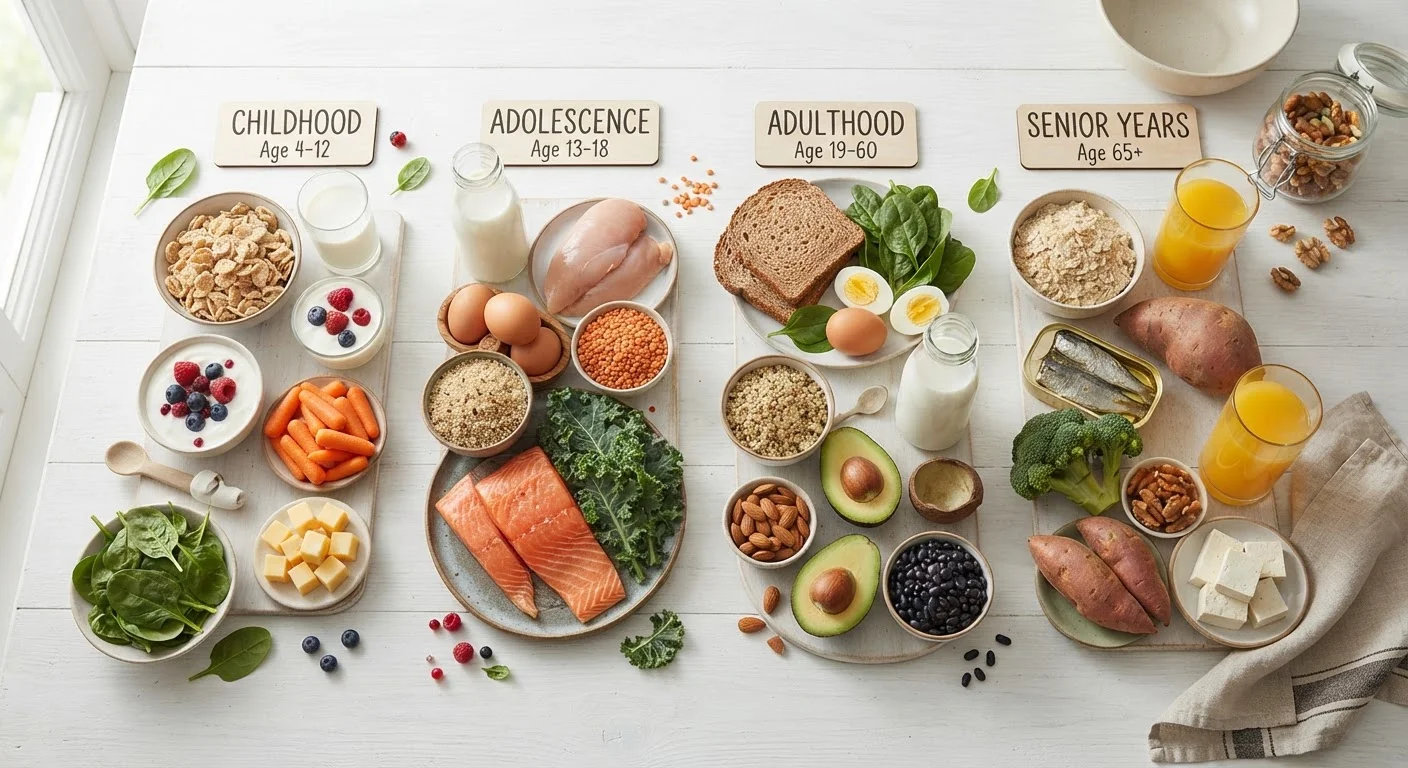
Eating a varied, whole-food diet remains the most reliable strategy for meeting shifting micronutrient needs at any age. Dairy products, fortified plant milks, leafy greens, legumes, and fatty fish collectively cover many of the nutrients that tend to become harder to obtain with age. However, dietary patterns, health conditions, and medications can all affect absorption—meaning food alone isn't always sufficient.
Routine health screenings and checkups often include blood panels that can flag deficiencies in vitamin D, B12, and iron before they become symptomatic. These results provide a more personalized picture than population-level RDAs alone. Similarly, because immune function is closely linked to micronutrient status, how immune needs shift across adulthood offers useful context.
Special populations—including pregnant individuals, older adults managing chronic conditions, and those on restrictive diets—face additional considerations that go beyond general guidelines. Consulting a registered dietitian or physician is the appropriate path for personalized guidance.
This article is for general informational and educational purposes only and is not a substitute for professional medical or nutritional advice. Always consult a qualified healthcare provider before making changes to your diet or supplement routine.