

Key Takeaways
- Habits form through a repeating loop of cue, routine, and reward encoded in the brain's basal ganglia.
- Research suggests consistent repetition in a stable context — not willpower — is what makes habits stick.
- Small, incremental changes are more likely to become permanent than dramatic lifestyle overhauls.
- On average, it takes 66 days for a new behavior to become automatic, though this varies widely by person and habit.
- Linking a new habit to an existing one — called habit stacking — significantly improves adherence.
Habit Formation
Habit formation is the process by which repeated behaviors become automatic over time. When an action is performed consistently in response to the same cue, the brain gradually encodes it as a routine, reducing the mental effort required to carry it out. This neurological shift is what makes habits feel effortless — and hard to break.
Habit learning is primarily driven by the basal ganglia, a brain region involved in procedural memory and reward processing, distinct from the prefrontal cortex that governs deliberate decision-making.
How the Brain Turns Behavior into Habit
Every habit you have — from brewing coffee in the morning to locking the door at night — began as a deliberate, effortful action. Over time, through repetition, your brain converted it into something automatic. That transformation happens in a specific region called the basal ganglia, which handles routine, procedural memory, and reward-based learning.
Neuroscientists describe this process through what is commonly called the habit loop: a three-part cycle consisting of a cue (a trigger that initiates the behavior), a routine (the behavior itself), and a reward (a positive outcome that reinforces the cycle). Each time this loop completes, the neural pathway associated with it strengthens — a principle sometimes summarized as "neurons that fire together, wire together."
Critically, this encoding process frees up the prefrontal cortex — the brain's seat of deliberate thinking — to focus on new problems. This is why experienced drivers can navigate familiar routes while holding a conversation. The habit has been delegated to a more efficient system.
“Habits are not a finish line to be crossed; they are a lifestyle to be lived. The goal is not to make one dramatic change but to make the right small changes consistently.”
— Wendy Wood, Research psychologist and author specializing in the science of habit
Why Small Changes Outperform Big Overhauls
It is tempting to treat the new year, a health scare, or a milestone birthday as the moment for a total lifestyle reset. But behavioral science consistently shows that sweeping changes are difficult to sustain. The reason is partly neurological and partly motivational.
Large behavior changes require high and sustained activation energy — the cognitive effort to begin an action. When motivation dips, as it inevitably does, the gap between intention and behavior widens. Small changes, by contrast, require so little activation energy that they are easy to start even on low-energy days.
Small habits also deliver earlier and more frequent reward signals. When a new behavior produces a recognizable positive outcome quickly — even a minor one like feeling more organized after a two-minute tidy — the brain's reward circuitry reinforces it. This positive feedback loop accelerates the formation of the habit pathway.
Start Smaller Than Feels Meaningful
If a new habit feels almost embarrassingly easy, you have probably sized it correctly for long-term success. A two-minute version of any habit — a short walk, a few deep breaths, a single journal sentence — is enough to establish the cue-routine-reward loop. You can always build duration or intensity once the behavior is automatic.
For those interested in how these principles apply to specific health domains, building sustainable eating habits follows the same behavioral architecture — small, consistent dietary changes tend to outlast dramatic dietary overhauls.
Practical Strategies Grounded in Research
Understanding the science is useful only if it translates into practice. Several evidence-informed strategies improve the odds that a new habit will take hold.
- Habit stacking: Attach a new behavior to an existing reliable one. For example, doing a brief stretching routine immediately after brushing your teeth leverages an already-automated cue.
- Implementation intentions: Research by psychologist Peter Gollwitzer demonstrates that specifying when, where, and how you will perform a behavior — rather than simply intending to do it — substantially increases follow-through.
- Environment design: Modifying your surroundings to make desired behaviors easier and undesired ones harder is one of the most robust habit tools available. Keeping a water bottle on your desk, for instance, removes friction from the habit of staying hydrated.
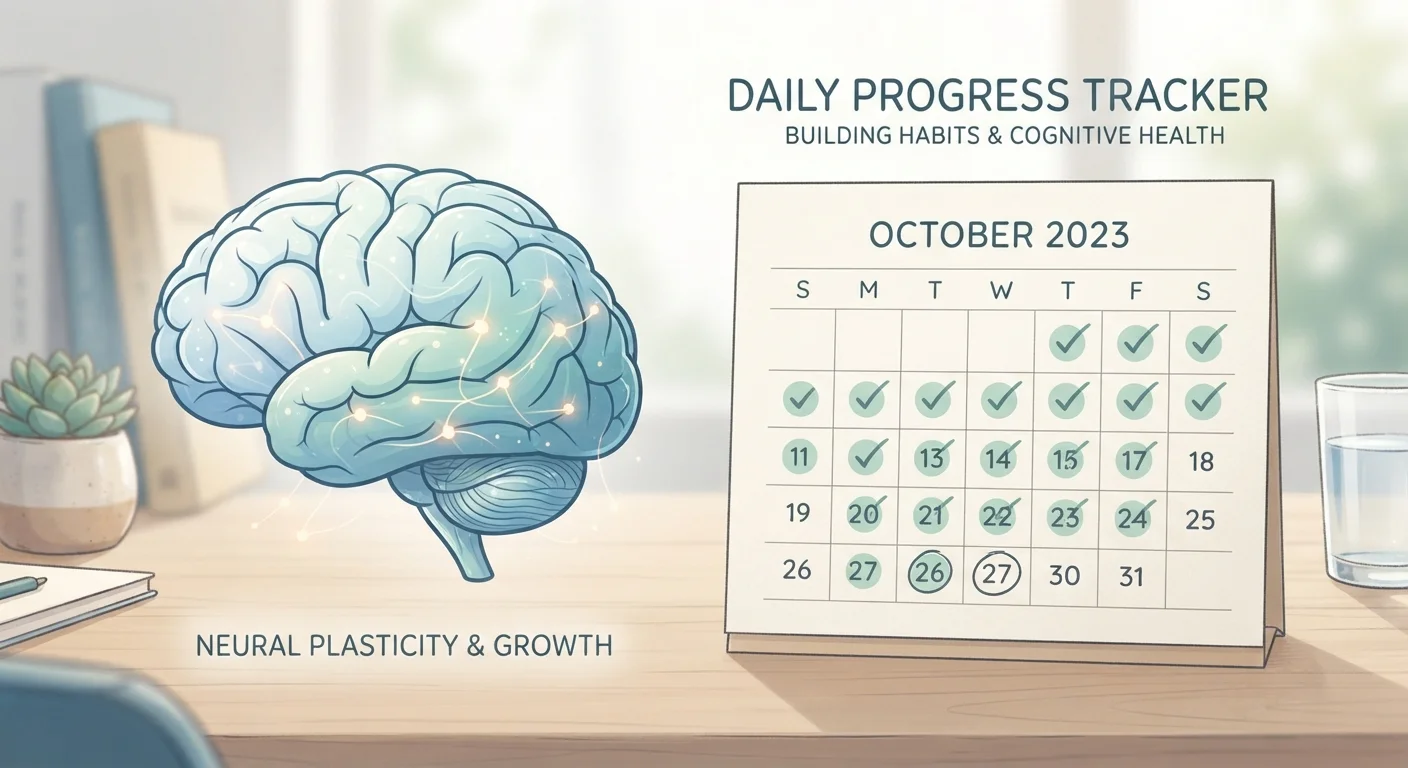
- Tracking and acknowledgment: Brief self-monitoring — even a simple checkmark on a calendar — activates the brain's reward pathway and reinforces the routine.
66 days
Average time for a behavior to become automatic
According to a study by Phillippa Lally and colleagues published in the European Journal of Social Psychology, habit automaticity averaged 66 days, ranging from 18 to 254 days.
~40%
Daily actions driven by habit, not deliberate choice
Research by Wendy Wood and colleagues at Duke University estimated that roughly 40% of daily behaviors are habitual rather than consciously decided in the moment.
2–3×
Improved follow-through with implementation intentions
Meta-analyses of implementation intention research by Peter Gollwitzer suggest that specifying when, where, and how to act can double or triple goal achievement rates compared to vague intentions.
These strategies become especially important when life gets disrupted. For a deeper look at maintaining habits through challenging periods, see approaches that hold up in real life.
It is also worth noting that habits affecting mood, recovery, and longevity are interconnected. The same mechanisms that help you build a walking habit apply equally to daily habits tied to emotional stability and recovery practices that compound over time.
This article is for informational purposes only and does not constitute medical advice. Consult a qualified healthcare professional before making significant changes to your health routine, particularly if you have an existing medical condition.