

Key Takeaways
- OSA is caused by physical airway obstruction; CSA results from the brain failing to signal breathing muscles.
- Loud snoring is a hallmark of OSA but is typically absent in CSA.
- Both conditions can cause fragmented sleep, daytime fatigue, and serious long-term health consequences.
- Accurate diagnosis requires a formal sleep study — symptoms alone cannot reliably distinguish the two.
- Treatment approaches differ substantially between OSA and CSA; what works for one may not suit the other.
Option A
Obstructive Sleep Apnea (OSA)
The most common form — a structural airway problem.
Best for: Understanding the type most often linked to snoring, excess weight, and anatomical airway features.
Option B
Central Sleep Apnea (CSA)
A neurological mismatch between brain and breathing muscles.
Best for: Understanding the less common but clinically distinct form tied to brain signaling failures.
If you snore loudly and wake gasping or choking
Obstructive Sleep Apnea (OSA)
These symptoms strongly suggest a physical airway blockage. A clinician can assess risk factors like neck circumference, nasal anatomy, and body weight.
If you have heart failure, neurological conditions, or use opioid medications
Central Sleep Apnea (CSA)
CSA is more frequently associated with these underlying conditions. Evaluation should address both the sleep disorder and its underlying driver.
If you have daytime sleepiness but no obvious snoring or risk factors
Obstructive Sleep Apnea (OSA)
OSA can occur without disruptive snoring, particularly in women and older adults. A sleep study remains the definitive diagnostic tool.
What Each Condition Actually Is
Both obstructive sleep apnea and central sleep apnea involve repeated pauses in breathing during sleep, but the mechanism behind those pauses is fundamentally different. That distinction shapes everything — from how each is diagnosed to how it's managed.
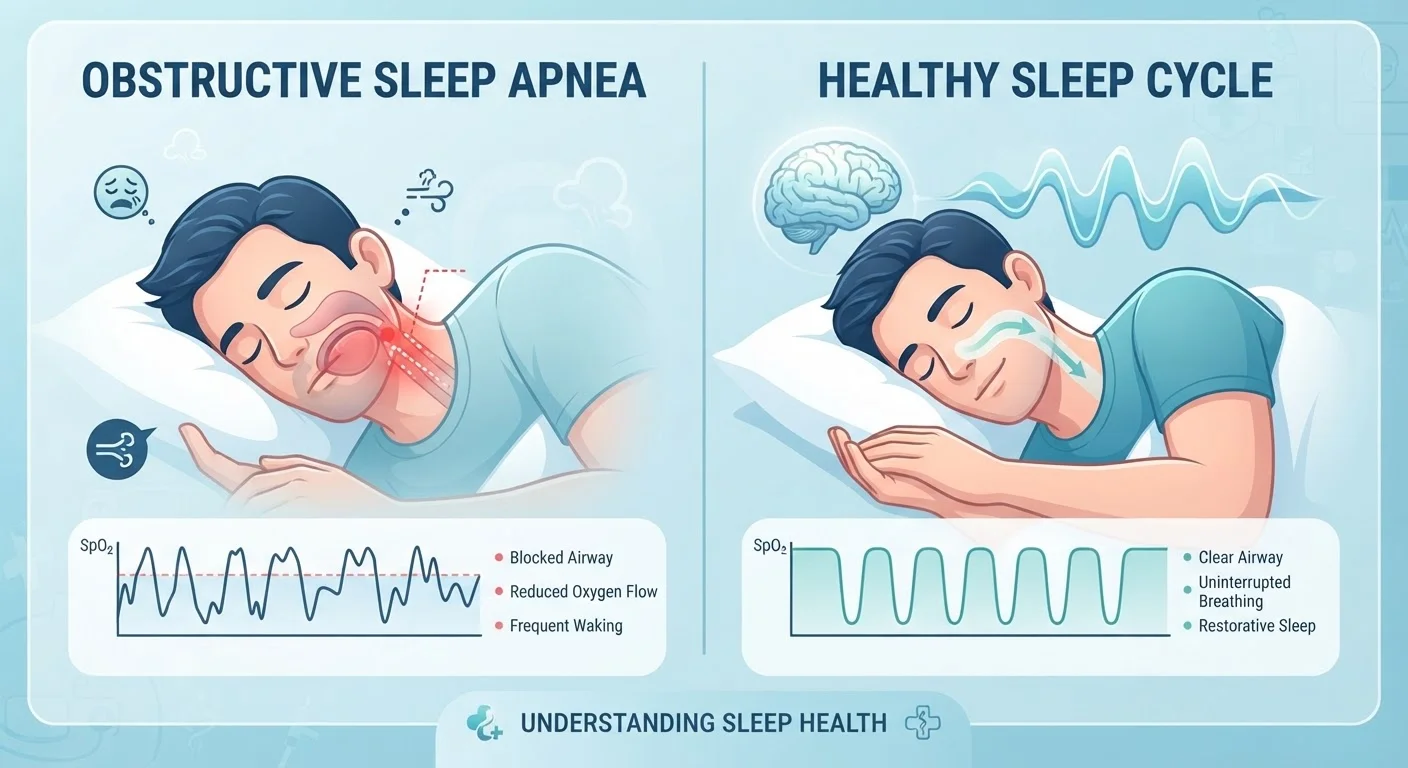
Obstructive sleep apnea (OSA) occurs when the muscles and soft tissues at the back of the throat relax too much during sleep, partially or fully collapsing the upper airway. The brain continues sending signals to breathe, but airflow is physically blocked. The sleeper typically responds with a gasp, snort, or brief arousal — often without waking consciously — and the cycle repeats throughout the night.
Central sleep apnea (CSA) is a neurological problem. The airway itself remains open, but the brain temporarily fails to send the correct signals to the respiratory muscles. There is no struggle against an obstruction; breathing simply pauses because the command to breathe isn't issued reliably. CSA is less common than OSA and is more frequently associated with underlying conditions such as heart failure, stroke, or the use of certain medications including opioids.
For a broader overview of sleep disruptions and where apnea fits within the landscape of sleep medicine, see our guide to common sleep disorders.
| Criterion | Obstructive Sleep Apnea | Central Sleep Apnea |
|---|---|---|
| Root cause | Physical airway collapse | Brain signaling failure |
| Airway during event | Blocked or narrowed | Open but inactive |
| Snoring | Common and often loud | Usually absent |
| Common associations | Obesity, anatomy, age | Heart failure, opioids, stroke |
| Prevalence | Very common | Less common |
| Primary treatment | CPAP, oral appliances | Treat underlying cause, specialized pressure therapy |
| Diagnostic tool | Sleep study (polysomnography) | Sleep study (polysomnography) |
Symptoms, Risk Factors, and Who's Most Affected
The two conditions share some surface-level symptoms — unrefreshing sleep, daytime fatigue, difficulty concentrating — but their distinguishing features are clinically meaningful.
OSA is strongly associated with loud, habitual snoring, witnessed breathing pauses, and waking with a dry mouth or headache. Key risk factors include excess weight, a large neck circumference, nasal congestion, anatomical features of the jaw or palate, and being male or postmenopausal. Age increases risk across all groups. Importantly, OSA can occur in people who are not overweight and in those who don't snore noticeably — a common misconception addressed in our article on myths that delay sleep disorder diagnosis.
CSA, by contrast, tends to present without prominent snoring. Those affected may notice insomnia, frequent nighttime awakenings, or shortness of breath when lying flat — symptoms that overlap with the underlying cardiac or neurological condition often driving the problem. CSA is also a recognized complication of high-altitude exposure, where reduced oxygen levels disrupt the brain's respiratory control mechanisms.
~30M
Americans estimated to have OSA
The American Academy of Sleep Medicine estimates roughly 30 million U.S. adults have obstructive sleep apnea, with many cases undiagnosed.
<1%
General population prevalence of CSA
Central sleep apnea affects a small fraction of the general population but rises significantly among people with heart failure or neurological conditions.
A mixed form — called complex sleep apnea syndrome or treatment-emergent central apnea — can also occur when OSA treatment reveals or triggers a central component, highlighting the need for proper post-treatment monitoring.
Diagnosis and Treatment: Why the Difference Matters
Distinguishing OSA from CSA requires a formal sleep study (polysomnography), which measures airflow, breathing effort, oxygen levels, and brain activity simultaneously. A home sleep apnea test can screen for OSA in many adults, but it is generally not sufficient to evaluate CSA or complex presentations. Only a qualified clinician can interpret results and recommend next steps — self-diagnosis based on symptoms alone is unreliable.
Treatment paths diverge considerably. OSA is most commonly treated with continuous positive airway pressure (CPAP) therapy, which delivers a steady stream of pressurized air to keep the airway open. Positional therapy, oral appliances, and in some cases surgery may also be appropriate depending on severity and anatomy.
CSA treatment focuses first on addressing the underlying cause — optimizing heart failure management, adjusting medications, or acclimatizing to altitude, for example. Specialized pressure therapies (such as adaptive servo-ventilation, or ASV) are sometimes used, though their appropriateness varies by individual clinical profile. Applying standard CPAP to CSA without proper evaluation may be ineffective or, in certain cardiac conditions, potentially inadvisable.
For a structured overview of how clinicians approach treatment decisions across sleep disorder types, our treatment pathways overview provides useful context. And if you're uncertain whether your sleep trouble represents something more persistent, the comparison in chronic insomnia vs. short-term sleep trouble may help frame your next conversation with a provider.
This article is for general informational purposes only and does not constitute medical advice. If you are experiencing symptoms of a sleep disorder, please consult a qualified healthcare professional for evaluation and guidance.