
Sleep Restriction vs. Sleep Extension: Two Opposite Approaches to Sleep Problems

Key Takeaways
- Sleep restriction therapy reduces time in bed to match actual sleep ability, helping to consolidate fragmented sleep.
- Sleep extension increases total sleep opportunity and is studied primarily in people who are chronically under-sleeping.
- Sleep restriction is a core component of Cognitive Behavioral Therapy for Insomnia (CBT-I), currently the first-line clinical approach.
- Neither approach is universally appropriate — the right fit depends on the underlying sleep problem.
- Both strategies require consistency with sleep-wake schedules to be effective.
- A qualified healthcare professional should guide decisions about structured sleep interventions.
Option A
Sleep Restriction Therapy
The counterintuitive approach that limits time in bed to consolidate sleep.
Best for: Best studied in people with chronic insomnia who spend excessive time in bed but achieve little actual sleep.
Option B
Sleep Extension
The recovery-focused strategy of deliberately increasing total sleep opportunity.
Best for: Most relevant for people who are chronically sleep-deprived due to lifestyle, work demands, or recovery needs.
If you lie in bed for many hours but sleep poorly or fitfully
Sleep Restriction Therapy
Spending excessive time in bed while sleeping poorly can reinforce the association between bed and wakefulness. Sleep restriction aims to rebuild that connection by compressing the sleep window.
If your schedule regularly cuts sleep short and you feel chronically tired
Sleep Extension
If insufficient opportunity — not poor sleep quality — is the core problem, extending total sleep time is the more logical starting point.
If you have been diagnosed with chronic insomnia
Sleep Restriction Therapy
Sleep restriction is a structured component of CBT-I, the intervention with the strongest clinical evidence for chronic insomnia.
If you are recovering from illness, intense training, or significant sleep debt
Sleep Extension
Research on recovery and athletic performance suggests that additional sleep opportunity can support physiological restoration during demanding periods.
Two Opposite Strategies, One Goal
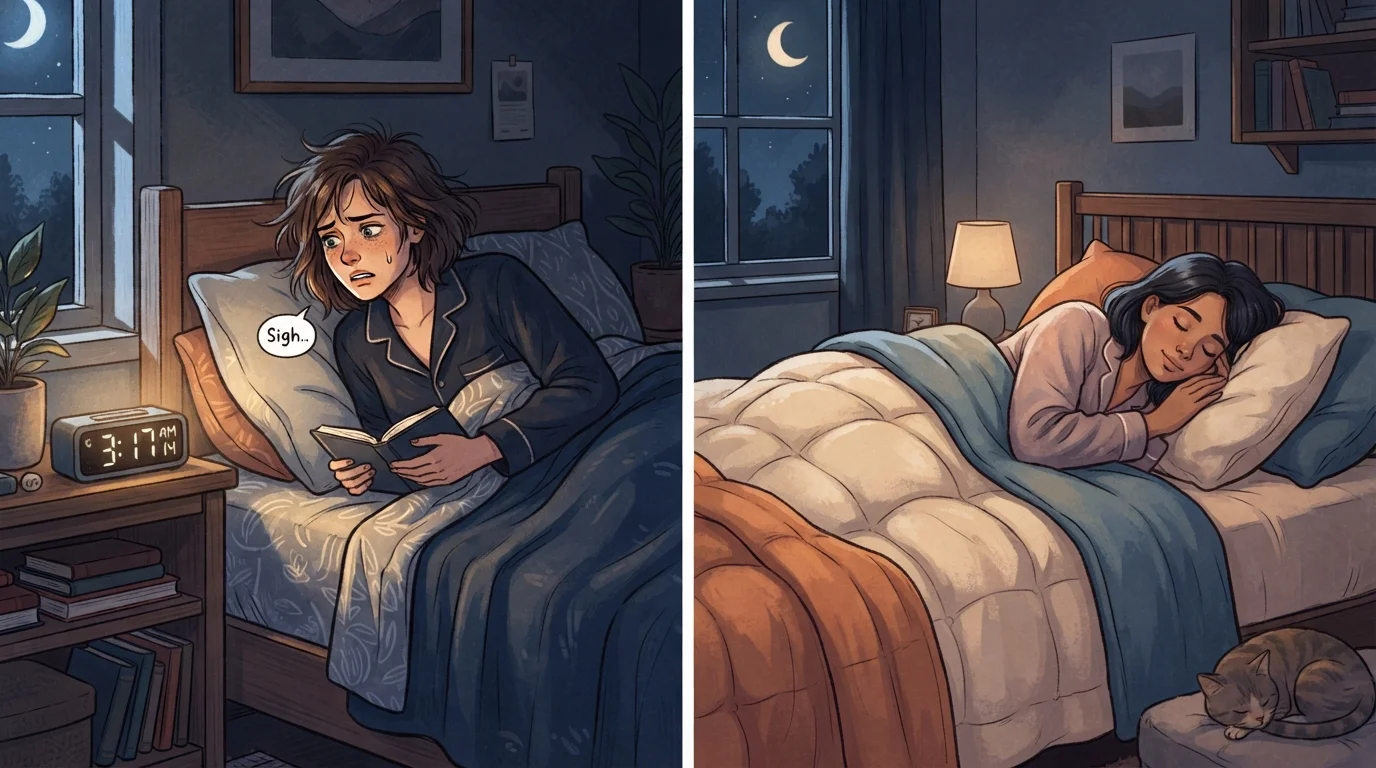
At first glance, sleep restriction and sleep extension appear to be direct opposites — one reduces the time you spend in bed, the other increases it. Yet both are studied as responses to sleep problems, just for very different underlying situations.
Understanding which approach applies to which problem requires looking at the mechanism behind each. Sleep difficulties are not monolithic. Someone who lies awake for hours despite exhaustion faces a fundamentally different challenge than someone who simply never allows themselves enough time to sleep. These two people may both complain of fatigue, but the clinical picture — and the appropriate response — differs considerably.
For a broader overview of the conditions that can disrupt rest, see Sleep Disorders Explained. And if you're unsure whether your sleep trouble is occasional or chronic, Chronic Insomnia vs. Short-Term Sleep Trouble walks through how clinicians distinguish between the two.
Sleep Restriction Therapy: What It Involves
Sleep restriction therapy — a core component of Cognitive Behavioral Therapy for Insomnia (CBT-I) — works by temporarily limiting the amount of time a person spends in bed to more closely match the amount of time they actually sleep. If someone spends nine hours in bed but genuinely sleeps only five, the approach might initially compress the sleep window closer to that actual sleep time.
The rationale is rooted in sleep drive, the biological pressure that builds with wakefulness. By reducing time in bed, sleep restriction intensifies that pressure, making sleep more consolidated and efficient over time. As sleep efficiency improves — typically measured as the percentage of time in bed spent asleep — the sleep window is gradually extended.
| Criterion | Sleep Restriction Therapy | Sleep Extension |
|---|---|---|
| Core mechanism | Compresses time in bed to match actual sleep | Increases total sleep opportunity |
| Primary target population | Chronic insomnia sufferers | Chronically sleep-deprived individuals |
| Clinical evidence base | Strong; central to CBT-I | Moderate; strongest in performance research |
| Short-term experience | Intentional sleepiness initially | Improved alertness over time |
| Schedule consistency required | Yes — fixed wake time is essential | Yes — gradual, structured change |
| Professional guidance advised | Strongly recommended | Recommended for structured protocols |
This approach is demanding. Short-term sleep deprivation is expected and intentional. It is generally not recommended for people with certain conditions, including bipolar disorder, seizure disorders, or untreated severe sleep apnea, and should be undertaken with professional guidance. For more on how sleep timing affects outcomes, The Science Behind Sleep Schedules provides useful context.
Sleep Extension: What It Involves
Sleep extension takes the opposite tack: rather than restricting sleep opportunity, it deliberately increases it. This might mean going to bed earlier, waking later, or adding a structured nap — with the goal of reducing accumulated sleep debt or supporting recovery.
Research in this area has explored sleep extension in the context of athletic performance and recovery, as well as in populations carrying significant sleep debt due to work schedules or lifestyle demands. Some studies suggest that extending sleep opportunity in these groups is associated with improvements in reaction time, mood, and physical performance, though findings vary and effect sizes depend heavily on the individual's baseline sleep status.
~70%
Insomnia improvement rate with CBT-I
Meta-analyses of CBT-I, which includes sleep restriction, consistently report meaningful improvements in sleep onset and efficiency for the majority of participants.
1–2 hours
Typical nightly sleep deficit in adults
Population surveys in the U.S. suggest many working adults regularly obtain less than the recommended 7–9 hours, creating cumulative sleep debt over time.
It's worth noting that sleep extension does not imply sleeping as long as possible regardless of need. Excessive time in bed in people who do not have a true sleep deficit can sometimes be counterproductive, and is associated in observational research with poorer outcomes — though causality in such studies is difficult to establish. Sleep extension is most meaningful when it addresses a genuine gap between sleep need and sleep opportunity.
This article is for informational purposes only and is not a substitute for personalized medical advice. If you are experiencing persistent sleep difficulties, please consult a qualified healthcare professional.