

Key Takeaways
- Everyday routines contain dozens of underused movement opportunities that require no extra time.
- Brief, frequent bouts of movement contribute to your overall daily activity in measurable ways.
- Anchoring movement to existing habits - cooking, commuting, waiting - makes it easier to sustain.
- You do not need a gym or a scheduled workout to meaningfully increase your daily physical activity.
- Small movement habits compound into significant health benefits when practiced consistently over weeks and months.
Your Day Is Already Full of Movement Opportunities
Most people assume that being active means carving time out of an already packed schedule. In reality, the average American day is full of built-in pauses, transitions, and repetitive tasks - all of which can quietly double as movement opportunities with very little adjustment.
Researchers studying NEAT - the energy expended through all movement outside of structured exercise - have found that it can vary by up to 2,000 calories per day between individuals with similar body sizes. Much of that difference comes down to how people move, or don't move, during ordinary moments. For a deeper look at how these small bursts add up physiologically, see our article on movement snacks and the science behind short activity bursts.
The eight moments below are not tricks or hacks - they are practical ways to use time you already have. None require equipment, and all are adaptable to different fitness levels and physical abilities. As always, if you have an existing health condition or injury, consult a qualified healthcare professional before changing your activity habits.
Waiting for water to boil or coffee to brew
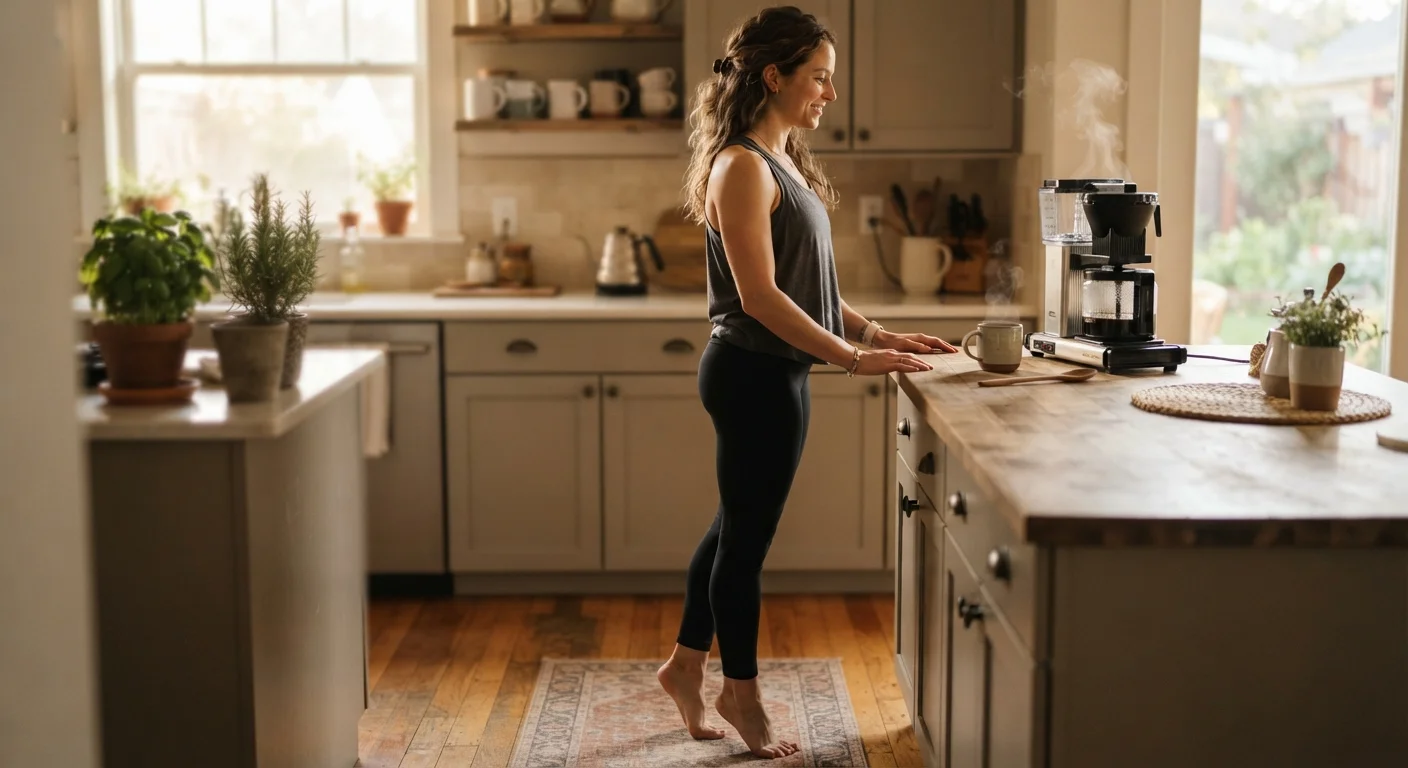
Kitchen wait times are typically two to five minutes - long enough to complete a meaningful movement break. Use the counter for support and cycle through calf raises, standing hip circles, or bodyweight squats. The counter provides stability if balance is a concern, making this accessible for most fitness levels.
Two minutes of calf raises while coffee brews is two minutes more than standing still.
Phone and video calls
Audio-only calls are one of the easiest opportunities to add steps. Walk a loop around your home or step outside. If you are on a video call, consider standing rather than sitting - research consistently associates prolonged sitting with poorer metabolic outcomes, and even standing introduces some postural muscle engagement. Let the agenda, not the habit of sitting, determine your position.
An audio call is a built-in walking window most people leave unused.
Commercial breaks and streaming pauses
The average hour of broadcast television includes about 15 minutes of commercials. Treating those breaks as movement intervals - a short walk to another room, a set of wall push-ups, or simply standing and stretching - can meaningfully reduce extended sedentary time without sacrificing the relaxation that evening TV provides.
Treating every commercial break as a standing cue disrupts long sedentary blocks effortlessly.
Waiting in line - at the store, pharmacy, or pick-up
Lines are involuntary pauses that most people spend scrolling a phone. Instead, practice small balance challenges: shift your weight slowly from foot to foot, perform subtle calf raises, or engage your core by standing tall with shoulders relaxed. None of these draw attention, and all activate muscle groups that support posture and stability.
Lines you cannot avoid become movement minutes you did not need to schedule.
Commute transitions - trains, buses, and parking lots
Public transit commuters can stand rather than sit when seats are available, and walk briskly between connections. Drivers can park at the far end of a parking lot or one stop early on a bus route. These small route adjustments add steps without requiring a single schedule change. For more strategies, see our guide on walking more without rearranging your schedule.
Parking farther away is an underrated strategy for adding steps with zero time cost.
Cooking and meal prep
Meal prep involves extended time on your feet with natural pauses between active tasks. Use stirring intervals for standing stretches, march in place while monitoring the stove, or do side steps between the counter and refrigerator rather than shuffling. The repetitive nature of chopping and mixing also pairs well with shoulder rolls and neck stretches that counteract desk posture.
Cooking already puts you on your feet - small movements in between tasks compound quickly.
Morning and evening routines
Brushing teeth takes roughly two minutes twice a day - enough time for standing single-leg balance practice, which supports ankle stability and coordination. Similarly, waiting for a shower to warm up or a face wash to rinse are moments that can anchor a few dynamic stretches. Bookending your day with micro-movement is one of the most durable habit designs because the cues are deeply automatic.
Two minutes of balance practice while brushing teeth adds up to over 24 hours a year.
Desk and work-from-home transitions
Remote workers lose the incidental steps that office environments generate - walking to meetings, visiting colleagues, commuting. Rebuilding that movement deliberately means treating task transitions as cues: stand up before starting a new document, walk to a different room for a glass of water between video calls, or set a soft alert to stand every 45-60 minutes. Our full checklist for incorporating movement into a work-from-home day walks through an auditable system for doing this consistently.
Remote workers can rebuild lost office steps by treating every task transition as a movement cue.
Building the Habit So It Sticks
Knowing an opportunity exists and actually using it are two different things. The most reliable bridge between them is habit stacking - attaching a new behavior to one you already perform automatically. When you decide that every time you wait for your coffee to brew you will do calf raises, the existing habit (making coffee) becomes the cue, and the movement follows without a decision. Learn more about this strategy in our guide on how habit stacking turns idle time into active time.
Start with one moment, not eight
Attempting to transform every item on this list at once is a reliable path to abandoning all of them. Pick the single daily moment that feels most natural - the coffee wait, the phone call, the commute - and practice that one anchor consistently for two weeks. Once it feels automatic, add another. This gradual layering is how small habits become durable ones.
The broader point is consistency over intensity. A single 45-minute workout three times a week is genuinely valuable, but it leaves roughly 165 waking hours that are largely sedentary for many people. Distributing small movements throughout those hours - even for 60 to 90 seconds at a time - is an evidence-supported complement to structured exercise, not a replacement for it. Over weeks and months, these habits compound in ways that are easy to underestimate at first. Our piece on the compounding effect of small movement habits explains how that progression works.
This article is for general informational purposes only and does not constitute medical advice. Speak with a qualified healthcare professional before making significant changes to your physical activity routine.