

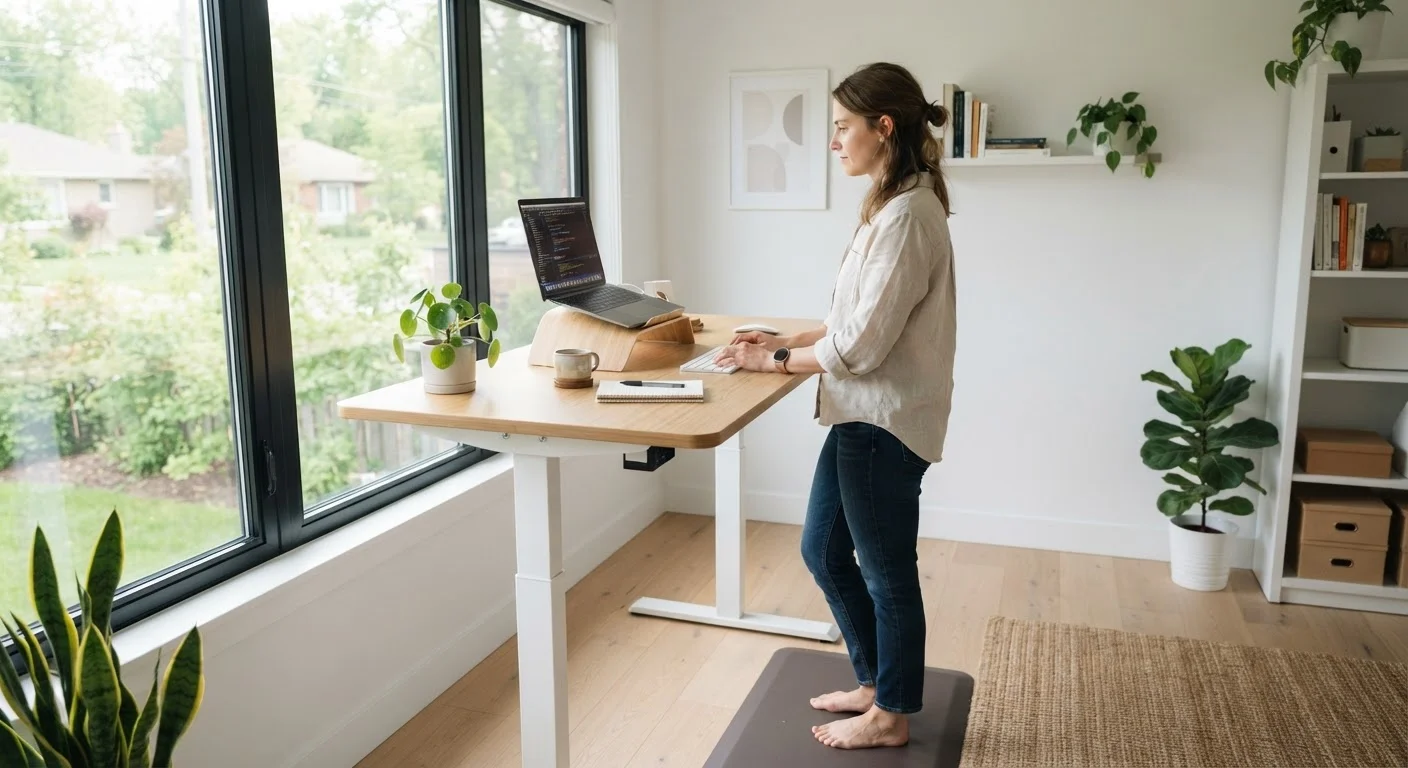
Key Takeaways
- Standing all day is not inherently healthier than sitting all day - both sustained postures carry risks.
- Alternating between sitting and standing on a regular schedule is broadly supported by exercise physiology research.
- Small, frequent movement breaks compound into meaningful fitness and metabolic benefits over time.
- A sit-stand routine works even without an adjustable desk, using low-cost alternatives like walk breaks or standing meetings.
- Consult a healthcare professional if you have pre-existing musculoskeletal or cardiovascular concerns before changing your workstation habits.
Option A
Standing Desks (Fixed Standing Position)
The always-upright, anti-sedentary workstation solution.
Best for: Workers who want a simple, commitment-free way to eliminate prolonged sitting without thinking about transitions.
Option B
Sit-Stand Routines (Alternating Postures)
The flexible, evidence-backed movement pattern for desk workers.
Best for: People who want to balance comfort and activity throughout the day by intentionally cycling between sitting and standing.
If you want the simplest possible way to reduce sitting time
Standing Desks (Fixed Standing Position)
A fixed standing desk removes the decision-making involved in posture switching and passively reduces sedentary time for those who struggle with consistent habits.
If you want the most evidence-supported, body-friendly approach
Sit-Stand Routines (Alternating Postures)
Research consistently suggests that alternating postures every 30-60 minutes reduces discomfort and avoids the fatigue and joint strain associated with prolonged standing.
If you experience back pain or lower-limb fatigue
Sit-Stand Routines (Alternating Postures)
Sustained standing can worsen varicose veins, lower-back discomfort, and foot pain. Scheduled transitions help manage load on muscles and joints across the workday.
If budget is a barrier and you cannot afford adjustable equipment
Sit-Stand Routines (Alternating Postures)
A sit-stand routine can be built around walk breaks, standing phone calls, or a simple elevated surface - no specialized desk required.
Why Posture Patterns Matter More Than the Desk Itself
The conversation around desk work and health has shifted considerably. For years, "sitting is the new smoking" headlines drove workers toward standing desks as a silver bullet. But exercise science tells a more nuanced story: the problem is not sitting itself - it is sustained, unbroken stillness in any single posture.
Both prolonged sitting and prolonged standing are associated with elevated discomfort, reduced circulation, and musculoskeletal strain. What the body benefits from is variety - regular posture changes that redistribute mechanical load, stimulate circulation, and interrupt metabolic stagnation. Understanding that distinction is the starting point for any meaningful comparison between a fixed standing desk and a deliberate sit-stand routine.
For a broader look at what the gap between sitting all day and moving just a little more actually means, see what the difference between sedentary and lightly active really means.
| Criterion | Fixed Standing Desk | Sit-Stand Routine |
|---|---|---|
| Posture variety | Low - single sustained posture | High - regular posture transitions |
| Risk of fatigue/strain | Moderate to high over time | Lower when transitions are timed well |
| Equipment needed | Fixed-height standing desk | Optional; walk breaks work without equipment |
| Habit complexity | Low - passive by design | Moderate - requires intentional scheduling |
| Metabolic benefit | Moderate vs. seated baseline | Comparable or greater with movement breaks |
| Evidence base | Mixed - benefits limited by sustained static load | Broadly supported by occupational health research |
The Case for Fixed Standing Desks
A fixed standing desk removes one cognitive barrier: you do not have to decide to change positions. For workers who find habit-building difficult, a desk that keeps them upright by default can genuinely reduce daily sedentary time. Some research also suggests that light standing activity after meals may support blood glucose regulation compared to seated rest.
The limitations, however, are real. Studies from occupational health research indicate that standing for more than two to four consecutive hours increases lower-back fatigue, worsens leg swelling, and can elevate cardiovascular strain for some individuals. Without an anti-fatigue mat, appropriate footwear, and a monitor at eye level, a fixed standing setup can introduce its own set of physical complaints - just different ones than prolonged sitting produces.
~2 hrs
Maximum recommended continuous standing before a break
Occupational health researchers generally recommend avoiding more than two hours of continuous standing to reduce lower-back strain and leg fatigue.
30-60 min
Recommended seated interval before standing or walking
Guidelines from exercise physiology and occupational health fields commonly suggest breaking up sitting at least every 30 to 60 minutes throughout the workday.
The Case for Sit-Stand Routines
A sit-stand routine - deliberately cycling between seated and standing positions throughout the workday - is consistently supported by exercise physiology research as the more body-friendly approach. The general principle behind it aligns with the broader concept of accumulated daily movement: small, frequent activity breaks compound into meaningful metabolic and musculoskeletal benefits over time.
A commonly cited guideline from occupational health researchers suggests aiming to break up sitting with short standing or walking intervals every 30 to 60 minutes. This does not require an adjustable standing desk. Standing during phone calls, walking to a colleague's workspace instead of messaging, or using a simple riser on a standard desk all apply the same principle.
These patterns connect directly to the evidence on movement accumulation. Structured exercise and accumulated daily movement serve different roles, and sit-stand transitions fall firmly into the accumulated movement category - small actions that add up without requiring a formal workout.
It is also worth noting that sit-stand routines complement, but do not replace, dedicated exercise. For perspective on how movement breaks relate to structured workouts, sedentary breaks and dedicated exercise offer distinct benefits and work best in combination.
Practical Guidance for Building a Smarter Workday
Whichever approach you lean toward, a few principles apply universally:
- Set a transition reminder. Apps, watch alerts, or simple timers help establish the habit of shifting posture before discomfort sets in.
- Adjust your setup ergonomically. Whether sitting or standing, monitor height, wrist position, and screen distance matter as much as the posture itself.
- Start gradually. If you are new to standing work, begin with 15-20 minutes of standing per hour and build tolerance over several weeks.
- Add micro-movement. Brief walking breaks, calf raises, or gentle stretching during posture transitions amplify the benefit beyond simply changing positions.
This article is for general informational and educational purposes only and does not constitute medical advice. If you have musculoskeletal conditions, circulatory concerns, or chronic pain, consult a qualified healthcare professional before making significant changes to your workstation or movement habits.