

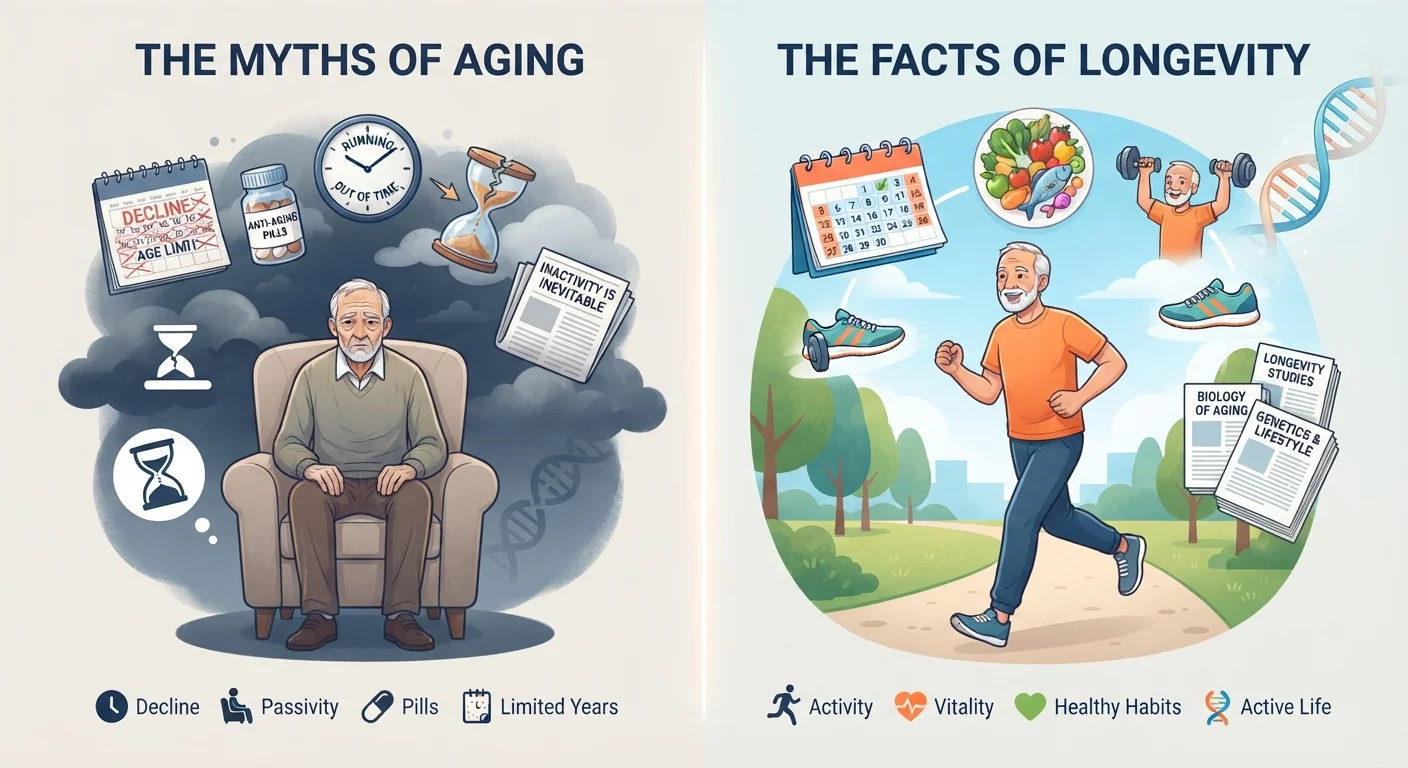
Key Takeaways
- Genetics account for roughly 20–30% of lifespan variation; lifestyle factors carry more weight than most people assume.
- Extreme calorie restriction has not been proven to extend human lifespan and carries meaningful health risks.
- Detox cleanses have no established scientific basis — the liver and kidneys handle that work continuously.
- Social connection and sleep quality are consistently underrated drivers of healthy aging.
- It is never too late to adopt beneficial habits; meaningful gains are possible well into later life.
Why Longevity Myths Persist
Americans spend billions each year on products and programs promising longer, healthier lives. Some of these reflect genuine science; many do not. The gap between compelling wellness narratives and rigorously tested evidence can be surprisingly wide — and acting on the wrong information may divert energy and resources away from habits that actually work.
Longevity research has accelerated considerably in recent decades, reshaping what scientists believe drives a long healthspan. Yet popular culture tends to lag behind, repeating ideas that researchers have largely moved past or significantly qualified. This article examines some of the most persistent misconceptions — and what current evidence supports instead.
For a deeper look at what the data actually shows about reaching 100 in good health, see our longevity research overview.
Myth
Your genes largely determine how long you'll live, so lifestyle choices matter less than most people think.
Fact
Genetic factors account for an estimated 20–30% of lifespan variation; modifiable behaviors and environment appear to explain the majority.
Twin studies published in leading journals have consistently found that shared genetics explain a minority of the difference in how long people live. Lifestyle factors — including physical activity, diet quality, sleep, smoking status, and social engagement — collectively carry more weight. This does not mean genetics are irrelevant, but it does mean most people have meaningful agency over their health trajectory.
Myth
Severe calorie restriction is one of the most proven strategies for extending human lifespan.
Fact
Dramatic calorie restriction has extended lifespan in some animal models but has not been demonstrated to do so in humans, and carries real health risks.
Research in organisms from yeast to rodents has shown that significant calorie restriction can extend lifespan under controlled conditions. However, translating this to humans is far more complex. Studies in primates have produced mixed results, and no controlled human trial has demonstrated a lifespan extension from severe restriction. Extreme restriction can lead to nutrient deficiencies, bone loss, and hormonal disruption. For comparison of what dietary timing approaches show in humans, see caloric restriction vs. time-restricted eating.
Myth
Periodic detox cleanses help the body eliminate toxins and reset for better health and longevity.
Fact
The body's liver, kidneys, and other organs handle detoxification continuously; no cleanse product has been shown to meaningfully enhance this process.
The concept of "detoxing" through juice cleanses, fasting protocols, or supplement regimens is not supported by clinical evidence. The liver metabolizes and neutralizes harmful compounds; the kidneys filter the blood and excrete waste products. These systems operate around the clock and are not meaningfully assisted by commercially marketed cleanses. Claims to the contrary are generally not backed by peer-reviewed research. For more on related misconceptions, see gut-immune myths.
Myth
Longevity is mostly about diet and supplements — social and psychological factors are secondary.
Fact
Strong social connection and psychological wellbeing are among the most consistently supported predictors of longer, healthier life in population research.
Large epidemiological studies, including research synthesized by the Harvard Study of Adult Development, point to the quality of social relationships as a powerful predictor of both health and longevity. Chronic loneliness and social isolation are associated with elevated risks for cardiovascular disease, cognitive decline, and earlier mortality. Sleep quality — often deprioritized in wellness culture — is similarly well-supported as a biological necessity for cellular repair and immune function. Diet and supplementation matter, but they do not substitute for these foundational factors.
Myth
Once you reach middle age or older, it's too late to make lifestyle changes that meaningfully improve longevity.
Fact
Research consistently shows that adopting healthier habits in midlife or later still produces measurable benefits for health outcomes and functional longevity.
Studies tracking individuals who quit smoking in their 50s and 60s, began regular physical activity in later life, or improved dietary patterns after age 60 have found meaningful reductions in disease risk and improvements in physical function. The body retains a degree of plasticity throughout adulthood. While earlier is generally better, beginning evidence-based habits at any stage is supported by the science. The Active Aging hub explores how movement supports health across the decades.
What Evidence-Based Longevity Actually Looks Like
Across the most credible research, a consistent picture emerges: the habits that support longer, healthier lives are not dramatic or exotic. Regular physical movement, sufficient restorative sleep, strong social ties, a predominantly whole-food dietary pattern, and not smoking appear repeatedly as meaningful contributors — while high-cost interventions often show little advantage over these fundamentals.
~25%
Lifespan variation explained by genetics
Twin studies consistently estimate that heritable factors account for roughly 20–30% of how long people live, with the rest attributable to environment and behavior.
150 min
Weekly moderate activity linked to lower mortality risk
Major health guidelines, including those from the CDC, recommend at least 150 minutes of moderate-intensity aerobic activity per week for adults based on mortality and disease risk data.
7–9 hrs
Recommended nightly sleep for adults
The American Academy of Sleep Medicine and Sleep Research Society recommend 7–9 hours of sleep per night for adults, citing associations with cardiovascular, metabolic, and cognitive health.
The role of genetics is real but often overstated. Studies of identical twins suggest that heritable factors account for roughly 20–30% of lifespan variation, leaving the majority attributable to environment and behavior. Our related article on lifestyle versus genetics explores this in more depth.
Exercise is one of the most robustly supported longevity behaviors. Concerns that it is "too late to start" or that older adults cannot benefit from strength training are addressed directly in our piece on aging and exercise myths. The evidence is clear: meaningful physiological adaptation is possible at virtually any adult age.
Similarly, nutrition claims in the longevity space deserve scrutiny. Many phrases that sound scientific — "detoxifying," "metabolism-boosting" — lack grounding in clinical evidence. See common nutrition claims that aren't scientific for a closer look.
This article is for general informational and educational purposes only and does not constitute medical advice. Consult a qualified healthcare professional before making changes to your diet, exercise routine, or health management plan.