

Key Takeaways
- The % Daily Value tells you how much a nutrient contributes to a general daily intake benchmark, not your personal needs.
- Serving size on a supplement can vary widely — always check it before comparing products.
- Bioavailability refers to how well your body absorbs a specific form of a nutrient.
- The Tolerable Upper Intake Level (UL) marks the threshold above which a nutrient may cause harm.
- "Other ingredients" and proprietary blends can obscure meaningful differences between supplements.
- A healthcare professional can help determine whether a supplement is right for your situation.
What you will need
Why Supplement Labels Feel Confusing
Supplement labels are governed by a different set of FDA rules than the Nutrition Facts panels you see on food packaging. If you are already comfortable with reading a standard nutrition label, you will recognize some elements — serving size, % Daily Value — but supplements introduce additional layers: chemical forms of nutrients, Tolerable Upper Intake Levels, proprietary blends, and third-party certification seals. Each of these details exists for a reason, and learning to read them together helps you evaluate what you are actually taking.
The steps below walk through each section of a supplement label in a logical reading order. You do not need any specialized knowledge to follow them — just a label and a few minutes of attention. For a parallel look at how labels on gut health products use their own set of specialized terms, see our field guide to gut health label claims.
What you will need
How to Read a Supplement Label Step by Step
Work through the label systematically using the steps below. Having the NIH Office of Dietary Supplements website open as a reference — particularly its individual nutrient fact sheets — makes this process considerably easier.
NIH Office of Dietary Supplements Fact Sheets
Provides science-based reference values for vitamins and minerals, including Recommended Dietary Allowances and Tolerable Upper Intake Levels.
USDA FoodData Central
Lets you cross-reference how much of a nutrient you may already be getting from food sources.
Check the serving size first
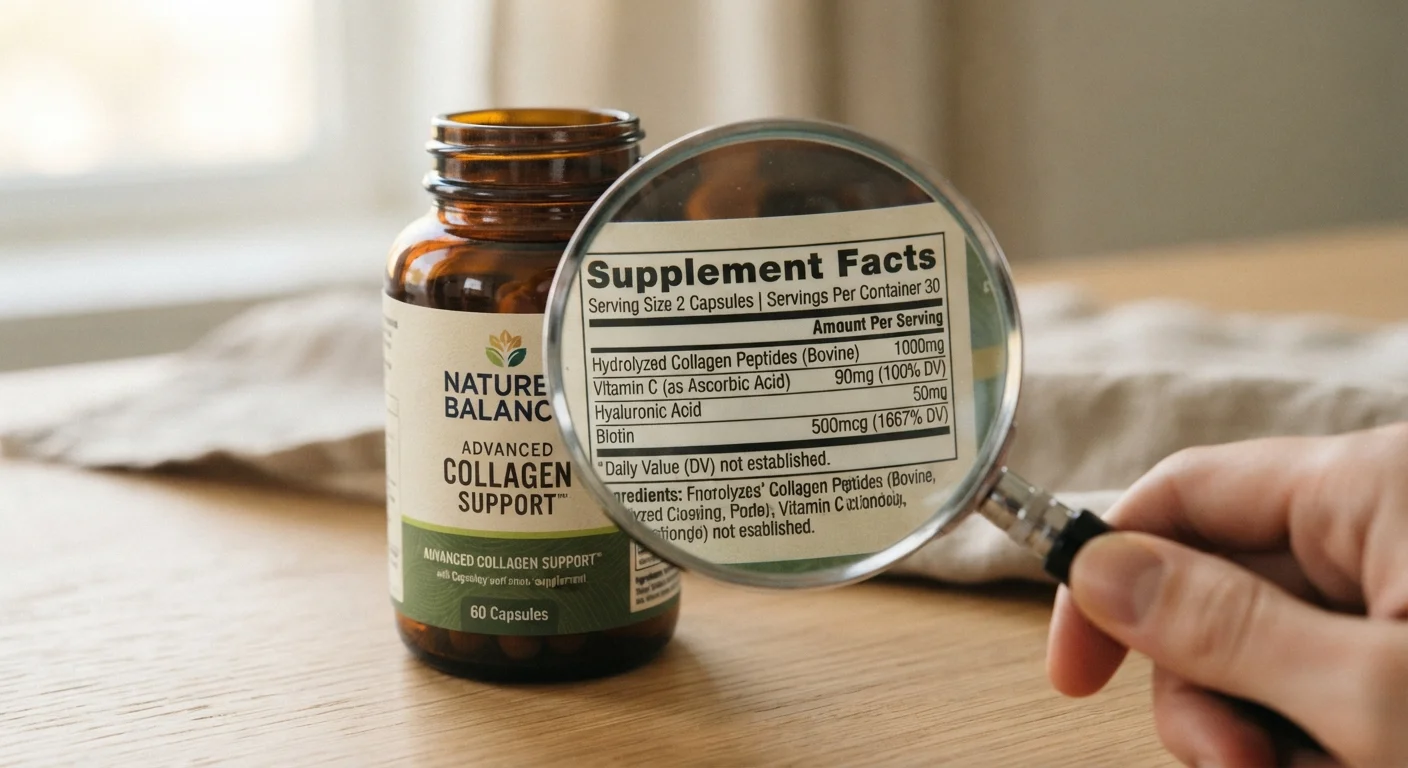
Every number on a supplement label is tied to a specific serving size — one capsule, two tablets, one scoop. Before reading anything else, confirm what one serving actually is. A label showing 500 mg of magnesium per serving means very little if the serving is three capsules and you plan to take one.
Interpret the % Daily Value correctly
The % Daily Value (%DV) is calculated against a standardized reference intake established by the FDA, based on a 2,000-calorie diet for a typical adult. A %DV of 100% means one serving provides the reference daily amount for that nutrient. However, your actual needs may differ based on age, sex, health status, and diet. The %DV is a useful benchmark for comparison, not a personal prescription. For context on how nutrients appear in whole foods, see our guide to whole foods vs. processed foods.
Identify the form of each nutrient
Supplements list nutrients by their chemical form: magnesium glycinate vs. magnesium oxide, for example, or folate vs. folic acid. The form matters because it affects bioavailability — how efficiently your body absorbs and uses the nutrient. Some forms dissolve more readily, some are gentler on digestion, and some are better suited to people with specific genetic variants. The NIH Office of Dietary Supplements publishes fact sheets on individual vitamins and minerals that describe commonly available forms.
Locate the Tolerable Upper Intake Level (UL)
The Tolerable Upper Intake Level (UL) is the highest daily amount of a nutrient that is unlikely to cause harm for most healthy adults, as established by the National Academies of Sciences. It is not printed on the label itself — you look it up separately using the NIH Dietary Supplement Fact Sheets. Compare the amount per serving on your label against the UL to understand how much headroom exists. This matters especially when you take multiple supplements or eat fortified foods, since nutrient intake adds up across sources.
Read the 'Other Ingredients' list carefully
Below the Supplement Facts panel, you will find an Other Ingredients list. This section discloses fillers, binders, capsule materials, preservatives, colorings, and allergens. Common entries include cellulose (a plant-based capsule material), silicon dioxide (an anti-caking agent), and soy or dairy-derived components relevant to people with food sensitivities. This section is frequently overlooked but can be significant if you have allergies or dietary restrictions.
Evaluate any proprietary blends with skepticism
Some supplements list a proprietary blend — a mixture of ingredients disclosed by total weight but without individual amounts. For example, a label might say "Herbal Support Blend: 400 mg" and list five ingredients underneath without specifying how much of each is present. This makes it impossible to assess whether any single ingredient is present in a meaningful amount. When evaluating a supplement with a proprietary blend, note that the total blend weight is the only number you can work with.
Check for a third-party verification seal
Unlike prescription drugs, dietary supplements in the United States are not required to be reviewed by the FDA before reaching store shelves. Third-party verification programs — such as USP, NSF International, and Informed Sport — test products for label accuracy, contaminant levels, and manufacturing quality. A seal from one of these organizations does not guarantee that a supplement will work for you, but it does indicate that the product was independently tested to contain what the label claims.
Cross-Check Nutrient Intake Across All Sources
Supplements are just one part of your total nutrient picture. Fortified breakfast cereals, protein powders, and energy drinks can all contribute meaningful amounts of vitamins and minerals. Adding up your full daily intake — food plus supplements — gives you a clearer sense of where you actually stand relative to recommended values and upper limits.
Supplements Are Not a Substitute for Medical Advice
This article provides general educational information about reading supplement labels. It is not medical advice and does not account for your individual health status, medications, or nutritional needs. Before starting any supplement, consult a qualified healthcare professional — particularly if you are pregnant, breastfeeding, managing a chronic condition, or taking prescription medications.
Common Misconceptions About Supplement Labels
A few widespread misunderstandings tend to lead people astray when reading supplement labels:
- "Natural" does not mean safe at any dose. Naturally derived nutrients can cause toxicity at high doses just as synthetic forms can. The source of a nutrient is separate from its safety profile at a given amount.
- A higher %DV is not always better. For many nutrients, the body absorbs what it needs and excretes the rest — but for fat-soluble vitamins and certain minerals, excess accumulates in tissue over time.
- The %DV reflects population averages, not your needs. Age, sex, pregnancy status, and existing deficiencies all affect what an appropriate intake looks like for a specific person.
More Is Not Always Better
Higher doses of a nutrient do not always mean greater benefit. Exceeding the Tolerable Upper Intake Level for certain vitamins and minerals can cause adverse effects, including toxicity symptoms. If your supplement provides several times the %DV for a nutrient, research that nutrient's UL before continuing use — and discuss the dose with a healthcare provider if you are uncertain.
This article is for general informational and educational purposes only. It is not a substitute for professional medical advice, diagnosis, or treatment. Always consult a qualified healthcare provider before making decisions about dietary supplements or your health.