

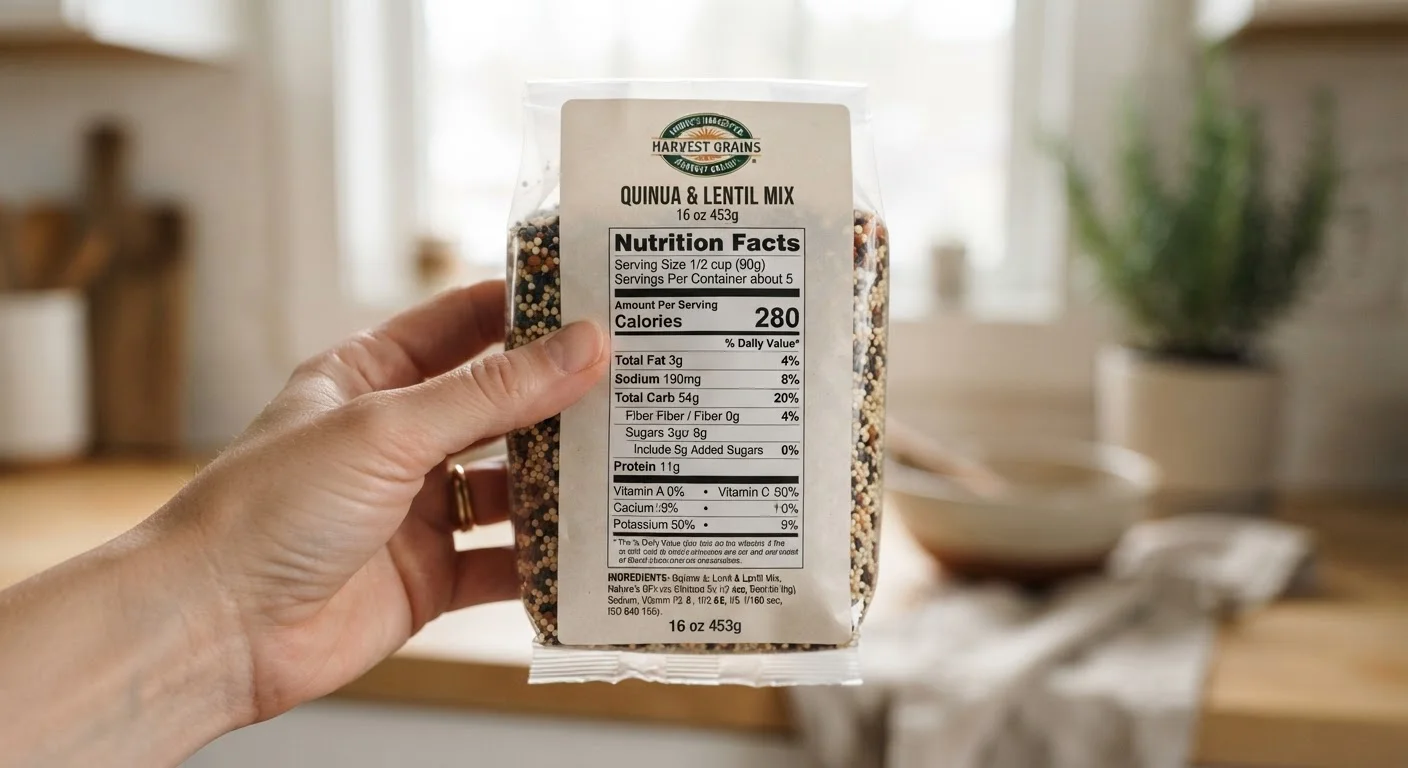
Key Takeaways
- Serving size is the reference unit for every number on the label — check it first.
- % Daily Value shows how much a nutrient contributes toward a 2,000-calorie reference diet.
- Saturated fat, sodium, and added sugars are nutrients most Americans consume in excess.
- Ingredients are listed by weight descending — the first ingredient dominates the product.
- Labels reveal what a food contains, not whether it matches your personal health goals.
Start here
Why Nutrition Labels Matter
Foundation
Serving Size: The Starting Point
Core concepts
Calories and Macronutrients
Go deeper
Micronutrients and % Daily Value
Next layer
The Ingredients List
Apply it
Putting It All Together
Why Nutrition Labels Matter
Every packaged food sold in the United States carries a Nutrition Facts label — a standardized panel required by the Food and Drug Administration (FDA). Despite being ubiquitous, most people scan labels without fully understanding what the numbers mean or how to apply them.
Labels aren't designed to tell you whether a food is 'good' or 'bad.' They're informational tools. The goal of reading one is to understand what you're actually consuming, so you can make choices that align with your own priorities — whether that's managing sodium, increasing fiber, or simply staying informed. For a broader look at what labels can and can't communicate about food quality, see our piece on whole foods vs. processed foods.
Serving Size: The Starting Point
The serving size is the anchor for everything else on the label. All calorie counts, grams, and percentages refer to one serving — not the whole package. Serving sizes are standardized by the FDA to reflect amounts people typically eat, but they may still differ from how much you actually consume.
Serving Sizes Can Be Smaller Than You Expect
Manufacturers set serving sizes based on typical consumption amounts, but these may be smaller than what most people actually eat. A bag labeled as '2.5 servings' will have 2.5 times the listed calories and nutrients if consumed entirely. Always check the serving size before drawing conclusions from any other number on the label.
Check how many servings are in the container before reading any other number. A small bag of chips labeled at 150 calories per serving with 3 servings contains 450 calories in total. This single step prevents the most common misreading of nutrition labels.
Calories and Macronutrients
Below the serving information, the label shows calories per serving — a measure of energy. Underneath that, you'll find the three macronutrients: fat, carbohydrate, and protein.
- Total Fat is broken into subtypes. Saturated fat and trans fat are listed separately because they have different health implications. Trans fat intake should be minimized; saturated fat guidelines recommend limiting intake, though research on this continues to evolve.
- Total Carbohydrate includes dietary fiber, total sugars, and — critically — added sugars, which are listed as a subgroup. Fiber generally has a beneficial role in digestive health; added sugars are what most dietary guidance recommends limiting.
- Protein is listed in grams but has no %DV displayed. Protein needs vary widely by individual.
For a deeper breakdown of how to interpret macronutrient grams in context, our guide on reading a nutrition label through a macronutrient lens covers this in detail.
Use %DV to Compare Products Quickly
When comparing two similar products, glance at the %DV column instead of the raw grams. A food with 20%+ DV for sodium per serving is considered high, while 5% or less is low. This shortcut works across nutrients and doesn't require memorizing specific numbers.
Micronutrients and % Daily Value
The lower section of the label lists key vitamins and minerals — typically Vitamin D, calcium, iron, and potassium. These are nutrients the FDA identified as commonly under-consumed in the American diet. The label shows their amounts in both absolute units and as % Daily Value (%DV).
Labels Reflect General Population References
The %DV figures are based on a 2,000-calorie diet used as a general reference — not as a target for everyone. Individual calorie and nutrient needs vary significantly based on age, sex, body size, activity level, and health conditions. Use these numbers as a comparative guide, not a personal prescription.
As a general rule of thumb established by the FDA: 5%DV or less per serving is considered low for a nutrient, and 20%DV or more is considered high. This makes it easy to spot, for example, that a food is a good source of calcium or that it's high in sodium — without needing to memorize the exact daily targets.
To understand micronutrients in more depth, explore the Vitamins & Minerals topic hub, or see how these principles extend to reading a supplement label.
Serving Size
The standardized portion amount that all nutrition information on the label refers to. It is not a recommendation of how much to eat.
% Daily Value (%DV)
A percentage showing how much of a nutrient one serving provides relative to the daily amount recommended for a 2,000-calorie diet.
Added Sugars
Sugars and syrups added to a food during processing or preparation, distinct from sugars that occur naturally in ingredients like fruit or milk.
Saturated Fat
A type of dietary fat found mainly in animal products and some tropical oils, typically solid at room temperature. Current dietary guidelines recommend limiting intake.
Sodium
A mineral and major component of salt, listed on labels in milligrams. High sodium intake is associated with elevated blood pressure in some individuals.
Ingredients List
A complete list of everything in a packaged food, ordered from most to least by weight. It appears separately from the Nutrition Facts panel.
The Ingredients List
Separate from the Nutrition Facts panel, the ingredients list shows every substance in the product, ordered from greatest to least by weight. The first ingredient makes up the largest proportion of the food — so if sugar or refined flour is first, the product is predominantly that ingredient.
The ingredients list is also where you'll find allergen information, food dyes, preservatives, and any added vitamins. It provides context the numbers panel alone can't. A product might show modest sugar grams while listing three different sweeteners that cumulatively rank high by weight. For products making gut health claims, our field guide to gut health label terms can help decode ingredient terminology.
FDA: How to Understand and Use the Nutrition Facts Label
The U.S. Food and Drug Administration's official guide walks through every section of the Nutrition Facts label with plain explanations and visual examples.
USDA Dietary Guidelines for Americans
The federal government's science-based dietary recommendations provide context for the nutrient benchmarks referenced on nutrition labels, including limits for sodium, saturated fat, and added sugars.
NIH Office of Dietary Supplements: Nutrient Fact Sheets
Detailed, research-grounded fact sheets on individual vitamins and minerals — useful when interpreting micronutrient information on food and supplement labels.
Putting It All Together
Reading a nutrition label well is a skill that becomes faster with practice. A useful sequence: check the serving size first, note calories, scan the nutrients you personally track or limit, then glance at the ingredients list for context.
No single number defines whether a food belongs in your diet. Labels are most useful when you use them comparatively — evaluating similar products side by side — or when you're tracking a specific nutrient over the course of a day. They're a tool for awareness, not a verdict.
If you're curious about what happens to those nutrients once you eat them, our article on digestion from start to finish follows the journey of food through your body.
This article is for general informational and educational purposes only. It is not a substitute for professional medical or dietary advice. Consult a qualified healthcare provider for guidance specific to your health needs.