
Mindfulness vs. Meditation: Understanding the Distinction and Choosing Your Practice

Key Takeaways
- Mindfulness is a quality of awareness; meditation is a formal practice used to cultivate it.
- You can practice mindfulness anywhere, anytime — no dedicated session required.
- Meditation encompasses many techniques, not all of which are mindfulness-based.
- Both approaches have credible research support for stress reduction and mental well-being.
- The two practices complement each other and are not mutually exclusive.
- Neither approach replaces professional mental health care when it is needed.
Option A
Mindfulness
Present-moment awareness woven into daily life.
Best for: People who want to reduce stress reactivity and build awareness throughout their existing routines without committing to a formal session.
Option B
Meditation
A structured mental training practice with defined technique.
Best for: People who benefit from a dedicated, repeatable session format to train focused attention, emotional regulation, or relaxation.
If you have limited time and want to start immediately
Mindfulness
Mindfulness can be integrated into activities you already do — eating, walking, or listening — requiring no extra time block in your schedule.
If you want a structured, skill-building mental training routine
Meditation
A regular meditation session provides a consistent container for deliberate practice, which research links to measurable changes in attention and stress response.
If you want the deepest long-term benefits
Mindfulness
Combining both — using meditation sessions to sharpen the skill and mindfulness to apply it throughout the day — produces the most comprehensive results according to current evidence.
If you find sitting still difficult or have past trauma
Mindfulness
Informal mindfulness during gentle movement or routine tasks can be a more accessible entry point; always consult a mental health professional if trauma is a concern.
Two Terms, One Relationship
The words mindfulness and meditation are frequently used as synonyms, but they describe different things. Understanding how they relate — and where they diverge — helps you choose a practice that actually fits your life.
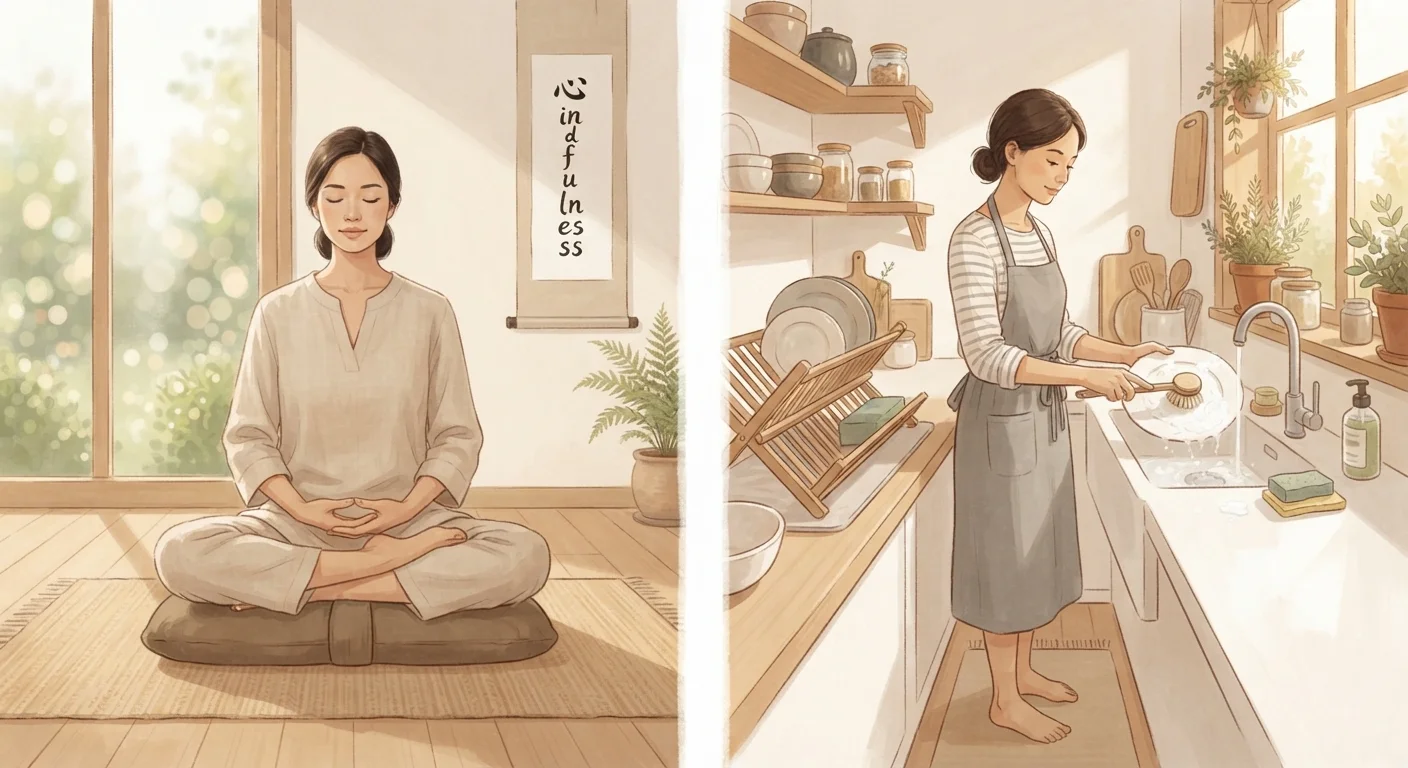
Mindfulness is a mental quality: the intentional, non-judgmental awareness of what is happening in the present moment. It is not a technique you do for 20 minutes and then stop. You can be mindful while commuting, eating lunch, or having a conversation. Everyday routines offer dozens of opportunities to practice this kind of attention.
Meditation, by contrast, is a structured activity — a deliberate practice session in which you apply a specific technique to train the mind. Some meditation techniques cultivate mindfulness; others do not. Loving-kindness meditation, visualization, mantra repetition, and body-scan practices are all forms of meditation, but they have distinct aims and methods. This means all mindfulness meditation is meditation, but not all meditation is mindfulness-based.
Think of the relationship this way: mindfulness is the destination, and certain meditation practices are one reliable road to get there. A closer look at how the two terms relate can help clarify this distinction further.
| Criterion | Mindfulness | Meditation |
|---|---|---|
| What it is | A quality of present-moment awareness | A structured practice session |
| When it happens | Anytime, integrated into daily life | During a dedicated time block |
| Requires dedicated time | No | Yes |
| Techniques involved | Paying attention, non-judgment | Many (focused attention, body scan, mantra, etc.) |
| Always mindfulness-based | Yes, by definition | Not always |
| Evidence base | Strong for stress, mood, attention | Strong for stress, attention, emotional regulation |
| Barrier to entry | Low — no equipment or session needed | Moderate — requires scheduling and technique |
What the Research Actually Shows
Both mindfulness and meditation have been studied extensively, though the quality of evidence varies considerably by condition and population. Here is what current science supports most consistently:
- Stress reduction: Mindfulness-Based Stress Reduction (MBSR), an eight-week structured program combining meditation and mindfulness skill-building, has the strongest clinical evidence, with multiple randomized trials showing reductions in perceived stress and anxiety symptoms.
- Attention and focus: Regular meditation practice — particularly focused-attention styles — is associated with improvements in sustained attention. Informal mindfulness may reinforce these gains outside of sessions.
- Emotional regulation: Both practices appear to support the ability to observe emotions without immediately reacting to them, a skill with implications for mood management.
It is worth noting that effect sizes in many studies are modest, and some research suffers from small samples or self-reporting bias. Reflective practices affect the brain in distinct ways, and the science continues to evolve. Mindfulness and meditation are well-supported wellness tools — not cures — and are best understood alongside, not instead of, professional mental health care when needed.
8 weeks
Duration of the most-studied mindfulness program (MBSR)
Mindfulness-Based Stress Reduction was developed at UMass Medical School and remains one of the most rigorously researched mindfulness interventions in clinical literature.
~14%
U.S. adults who reported meditating in the past 12 months
According to the 2017 National Health Interview Survey conducted by the CDC, meditation use among American adults nearly tripled between 2012 and 2017.
47%
Of waking hours spent mind-wandering, per Harvard research
A landmark study published in Science (Killingsworth & Gilbert, 2010) found that people's minds wander nearly half the time — a key reason attention training is of clinical interest.
Choosing a Practice That Works for You
Neither mindfulness nor meditation is universally superior. Your choice depends on your schedule, temperament, and goals. A few practical considerations:
- Time availability: If a 10–20 minute daily session feels realistic, formal meditation offers a structured starting point. If your schedule is genuinely fragmented, building mindful moments into existing activities — a concept explored in formal vs. informal practice — may be more sustainable.
- Preferred learning style: Some people thrive with guided audio sessions or apps; others do well reading about the concepts first and applying them informally. Neither approach is wrong.
- Existing challenges: People managing anxiety, depression, trauma, or chronic pain should discuss any new contemplative practice with a qualified healthcare provider before starting. Certain meditation techniques can occasionally intensify difficult experiences in vulnerable individuals.
For beginners, a practical introduction to starting small can lower the barrier to entry considerably. And if you are curious about what a sustained practice honestly involves, a balanced look at trade-offs is worth reading before you commit.
Most people find that combining both — using meditation sessions to build the skill and informal mindfulness to apply it — produces the broadest benefit. Start where you are, keep it simple, and adjust as you learn more about what supports your own well-being.
This article is for general informational purposes only and does not constitute medical or mental health advice. If you are experiencing significant stress, anxiety, depression, or other mental health concerns, please consult a qualified healthcare professional.