

Key Takeaways
- Each major cancer screening uses a different method tailored to how that cancer develops.
- Guidelines set specific age ranges and risk factors that determine who should be screened and when.
- Colorectal screening can both detect existing cancer and prevent future cancer by removing precancerous polyps.
- Cervical cancer screening has shifted from annual Pap tests to less-frequent HPV-based testing for most adults.
- Lung cancer screening with low-dose CT is reserved for people with a significant smoking history.
- Your personal risk factors may move your screening start date earlier — discuss your history with a clinician.
Cancer Screening
A cancer screening is a medical test performed on people who have no symptoms, with the goal of detecting cancer — or precancerous changes — before they cause problems. Finding abnormalities early, when they are most treatable, is the central purpose of every screening program. Different screenings target different organs and use different detection methods.
Screening tests are distinct from diagnostic tests: a screening flags potential concerns in an asymptomatic population, while a diagnostic test is used to evaluate a specific symptom or follow up on an abnormal screening result.
Why Different Cancers Require Different Tests
Cancer screenings are not one-size-fits-all. Each test is designed around the biology of a specific cancer — how it grows, where it starts, and what physical or molecular signs it leaves behind. Understanding what a test actually looks for removes much of the confusion about why guidelines recommend one test over another, and why timing varies so significantly between them.
For a broader introduction to how preventive testing works, see our first-timer's complete introduction to preventive screenings. This article focuses specifically on the four most widely recommended cancer screenings in the United States.
Screening vs. Diagnostic Testing: An Important Distinction
A screening test is performed on someone with no symptoms to look for early signs of disease. A diagnostic test is ordered when a symptom, abnormal finding, or positive screening result already exists. Insurance coverage, scheduling, and clinical interpretation can differ between the two. If you have symptoms — such as rectal bleeding, a breast lump, or a persistent cough — report them to a clinician promptly rather than waiting for a scheduled screening appointment.
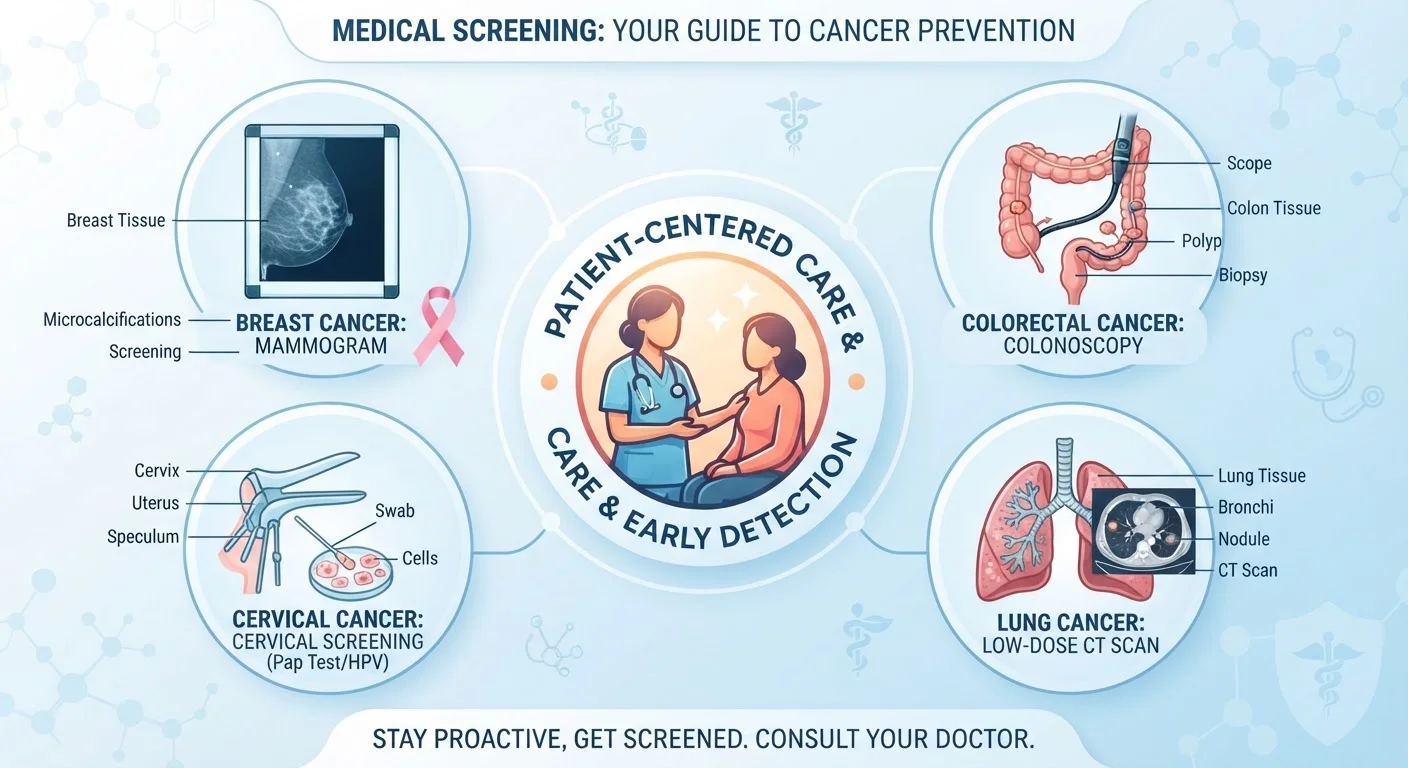
Colorectal Cancer Screening: Looking for Polyps and Tumors
Colorectal cancer begins in the lining of the colon or rectum, almost always developing slowly from small tissue growths called polyps. This gradual progression is what makes colorectal screening uniquely powerful — the right test can find and remove precancerous polyps before they ever become malignant.
The USPSTF recommends screening for average-risk adults starting at age 45 and continuing through age 75. Several test options exist, and they fall into two categories:
- Stool-based tests — including the fecal immunochemical test (FIT) and the FIT-DNA test — analyze a sample for blood or abnormal DNA shed by polyps or tumors. These are non-invasive and done at home, but require follow-up colonoscopy if results are positive.
- Visual exams — colonoscopy being the most common — allow a physician to directly view the colon's interior and remove suspicious tissue during the same procedure. A colonoscopy for average-risk adults is typically repeated every 10 years when results are normal.
Screening intervals and preferred methods may change based on personal or family history of colorectal cancer or polyps. Our guide to screening intervals explains how clinicians make those frequency decisions.
45
Age average-risk adults should begin colorectal screening
The USPSTF updated its recommendation from age 50 to age 45, reflecting rising colorectal cancer rates in younger adults.
~90%
5-year survival rate when colorectal cancer is caught early
According to the American Cancer Society, localized colorectal cancer detected before it spreads carries a roughly 90% five-year relative survival rate.
20 pack-years
Minimum smoking history to qualify for lung CT screening
USPSTF guidelines require at least a 20 pack-year history and current or recent smoking status within the past 15 years.
Cervical Cancer Screening: HPV and Cell Changes
Cervical cancer develops from abnormal cell changes in the cervix, the vast majority of which are caused by persistent infection with certain strains of human papillomavirus (HPV). Current screening reflects this biology directly.
USPSTF guidelines recommend:
- Ages 21–29: A Pap test (also called a Pap smear) every 3 years. This test collects a small sample of cervical cells and examines them under a microscope for abnormal changes.
- Ages 30–65: A high-risk HPV test alone every 5 years, or an HPV test combined with a Pap test (co-testing) every 5 years, or a Pap test alone every 3 years.
The shift toward HPV-primary testing reflects research showing that detecting the virus responsible for most cervical cancers is a more efficient strategy in adults 30 and older. Screening typically ends at 65 for people with adequate prior negative results and no high-risk history. Individuals who have had a hysterectomy removing the cervix for non-cancer reasons generally do not need cervical screening.
Breast Cancer Screening: Imaging for Masses and Tissue Changes
Mammography uses low-dose X-rays to create detailed images of breast tissue, enabling radiologists to identify masses, calcifications, or architectural distortions that may indicate cancer or precancerous changes. It remains the primary recommended tool for breast cancer screening in average-risk women.
Guideline recommendations vary somewhat between organizations. The USPSTF recommends biennial (every 2 years) mammography starting at age 40 through age 74 for average-risk women. The American Cancer Society recommends annual mammograms starting at 45, with the option to begin at 40. Women at higher risk — due to family history, genetic mutations such as BRCA1 or BRCA2, or prior chest radiation — may be advised to start earlier or add MRI screening. Discussing personal risk factors with a clinician is essential to determining the right approach.
People often have questions about false positives and follow-up procedures. It is worth noting that an abnormal mammogram result leads to additional imaging in many cases, but only a small percentage of those callbacks result in a cancer diagnosis. This is a normal part of the screening process, not cause for immediate alarm.
Lung Cancer Screening: Low-Dose CT for High-Risk Adults
Unlike the other three screenings discussed here, lung cancer screening is not recommended for the general population. It is targeted specifically at adults who have a significant history of smoking, where the risk-benefit calculation supports annual screening.
USPSTF guidelines recommend annual low-dose computed tomography (LDCT) for adults aged 50 to 80 who meet both of the following criteria: a 20 pack-year smoking history (equivalent to one pack per day for 20 years, or two packs per day for 10 years), and who currently smoke or have quit within the past 15 years.
LDCT creates cross-sectional images of the lungs that can reveal small nodules before they cause symptoms. Screening is discontinued if an individual has not smoked for 15 or more years or develops a health condition that would limit treatment options. Because lung nodules are common and most are benign, LDCT screening in ineligible populations would produce far more harm — unnecessary anxiety, biopsies, and procedures — than benefit.
If you have questions about how your screening history should evolve over time, see our overview of health screenings in your 30s. Cancer screenings are just one part of a broader preventive care picture that also includes metabolic screenings for blood pressure, cholesterol, and blood sugar.
This article is for general informational and educational purposes only and is not a substitute for professional medical advice, diagnosis, or treatment. Always consult a qualified healthcare provider about your personal screening schedule and risk factors.