

Key Takeaways
- Herd immunity protects vulnerable people who cannot be vaccinated by reducing overall disease spread.
- The immunity threshold varies by disease — measles requires roughly 95% coverage, while polio requires around 80–85%.
- Vaccination is the established, safer path to community immunity compared with natural infection.
- Coverage gaps — whether geographic, demographic, or due to hesitancy — can undermine community-wide protection.
- No community reaches 100% vaccination, so some level of ongoing risk always exists for susceptible individuals.
Herd Immunity
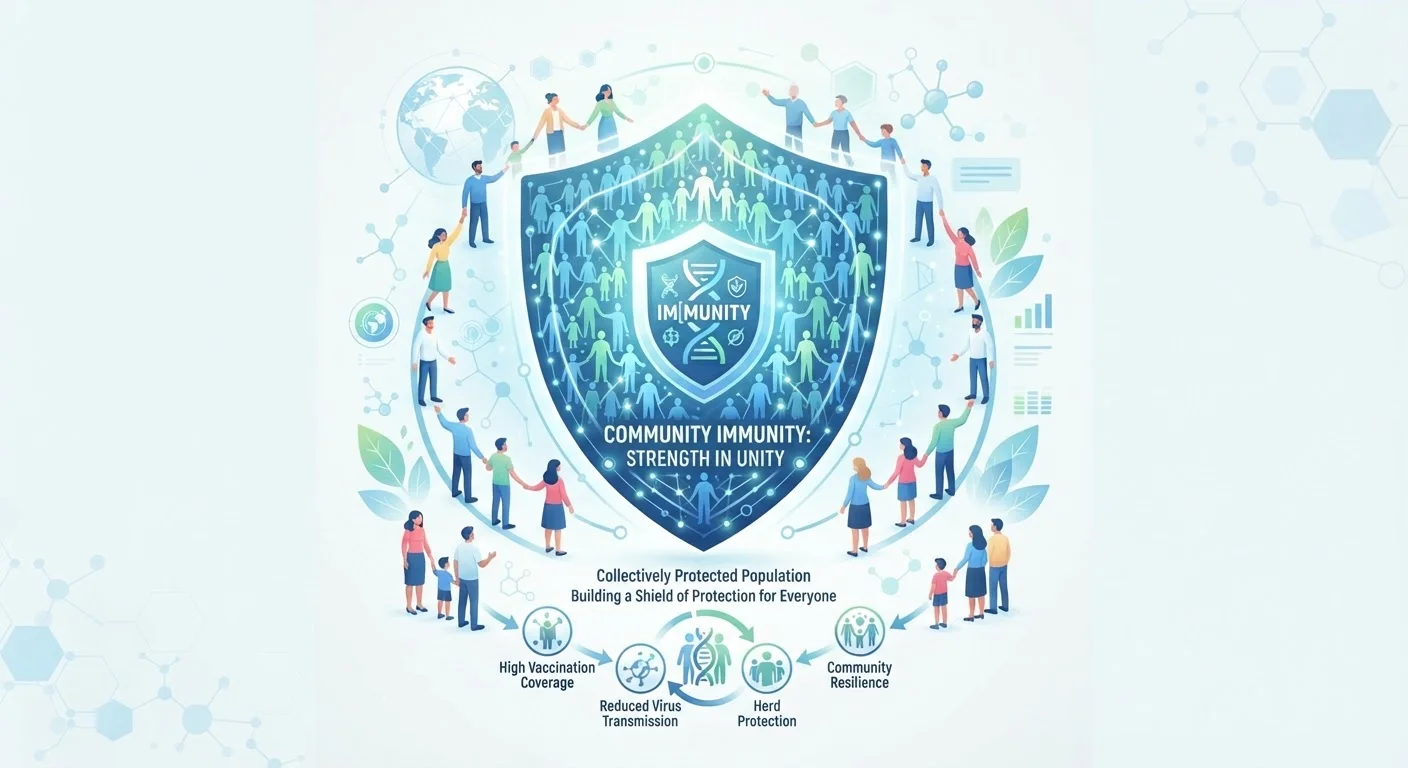
Herd immunity — also called community immunity — occurs when enough people in a population are immune to an infectious disease that its spread slows dramatically, protecting even those who cannot be vaccinated. This indirect protection arises because immune individuals act as a barrier, reducing the chances an infected person contacts someone susceptible. It can result from vaccination or prior infection, though vaccination is the safer and more controlled route.
The proportion of a population that must be immune to achieve herd immunity is called the herd immunity threshold, which is mathematically derived from a pathogen's basic reproduction number (R₀) — roughly 1 − (1/R₀).
The Core Idea: How Community Protection Works
When a contagious disease moves through a population, it needs susceptible people to keep spreading. Herd immunity disrupts that chain of transmission. If enough people are immune — through vaccination or prior infection — an infectious person is statistically more likely to encounter someone who cannot catch or pass on the disease. The pathogen effectively runs out of hosts, and spread slows or stops.
This matters enormously for people who have no choice about their susceptibility. Newborns, individuals undergoing chemotherapy, and those with certain autoimmune conditions may not be able to receive specific vaccines safely. Their protection relies on the immunity of the community around them. To understand how vaccination interacts with the immune system more broadly, see our overview on how the immune system works.
95%
Measles herd immunity threshold
The CDC and WHO identify approximately 95% population immunity as the coverage needed to interrupt measles transmission, reflecting the disease's very high contagiousness.
80–85%
Polio herd immunity threshold
Public health authorities estimate that 80–85% coverage with polio vaccine is sufficient to prevent endemic transmission in most settings.
~1 in 1,000
Measles complication rate (encephalitis)
The CDC estimates approximately 1 in 1,000 measles cases leads to encephalitis, underscoring why preventing circulation through herd immunity matters beyond individual protection.
Herd Immunity Thresholds: Why the Number Differs by Disease
Not every disease requires the same proportion of immune individuals to achieve community protection. The key variable is a pathogen's basic reproduction number, or R₀ — how many people, on average, one infected person spreads the disease to in a fully susceptible population. The higher the R₀, the more contagious the disease, and the higher the threshold required.
- Measles (R₀ ≈ 12–18): Requires roughly 95% community immunity — one of the highest thresholds known.
- Polio (R₀ ≈ 5–7): Requires approximately 80–85% coverage.
- Mumps (R₀ ≈ 4–7): Threshold estimated around 75–86%.
- Seasonal influenza (R₀ ≈ 2–3): Lower threshold, but complicated by annual strain variation and waning immunity.
These thresholds assume uniform distribution of immunity across a population — an assumption that rarely holds perfectly in practice.
Where Herd Immunity Breaks Down
Herd immunity is a population-level concept with real-world limitations. Several factors can erode or prevent community protection even when regional vaccination statistics look reassuring.
Geographic and Social Clustering
When unvaccinated individuals concentrate in the same schools, neighborhoods, or religious communities, local coverage can fall below the threshold even if a city's overall rate is adequate. Measles outbreaks in the United States during recent decades have repeatedly traced back to these clusters — not to low nationwide averages.
Waning Immunity
Some vaccines confer lifelong immunity; others do not. Pertussis (whooping cough) immunity from the acellular vaccine wanes more quickly than older formulations, which is one reason adolescent and adult booster doses are recommended. Adults who believe childhood vaccines still protect them fully may be inadvertently contributing to coverage gaps.
Vaccine Hesitancy
Declining vaccination rates driven by misinformation directly threaten community immunity. For an evidence-based look at persistent misconceptions, see vaccine myths and what the evidence actually shows. Understanding why hesitancy occurs is equally important — explored in depth in our article on why vaccine hesitancy happens.
What Individuals Can Do — and What Herd Immunity Cannot Replace
Community immunity is a shared resource, not a personal guarantee. Even in high-coverage populations, susceptible individuals remain at some risk. Vaccination is the most direct, evidence-supported action an individual can take — both to protect themselves and to contribute to the collective shield.
People with chronic illnesses or immunosuppression should discuss vaccine schedules with their healthcare provider, as specific recommendations may differ. Our article on vaccination and chronic illness covers this in detail.
Vaccination also works alongside other preventive measures. Handwashing, respiratory hygiene, and other layered defenses complement — but cannot substitute for — immunization. Learn more in our piece on preventive strategies beyond vaccines.
Check Your Own Vaccination Status
Adults often assume childhood vaccines still protect them fully — but some immunity wanes, and recommended schedules have changed over the decades. Ask your healthcare provider to review your immunization history and identify any boosters or vaccines you may have missed. Staying current is one of the most direct ways to contribute to community protection.
This article is for general informational and educational purposes only and does not constitute medical advice. Always consult a qualified healthcare professional for guidance specific to your health situation.