

Key Takeaways
- Vaccines teach the immune system to recognize a pathogen before you ever encounter it in the real world.
- Memory B and T cells created by vaccination can persist for years or even decades.
- Different vaccine platforms (mRNA, subunit, live-attenuated) all ultimately trigger the same adaptive immune response.
- Booster doses are sometimes needed because immunity can wane over time or because pathogens mutate.
- Individual vaccination also contributes to community-level protection by reducing transmission.
Vaccine-Induced Immunity
Vaccine-induced immunity is the protection your immune system develops after receiving a vaccine. Instead of learning to fight a disease by actually getting sick, your body is exposed to a harmless piece — or a blueprint — of the pathogen. This triggers an immune response and builds lasting memory so your body can respond quickly if real exposure ever occurs.
Depending on vaccine type, the active component may be a live-attenuated pathogen, an inactivated pathogen, a protein subunit, or mRNA encoding a specific antigen — each stimulating adaptive immunity through distinct mechanisms.
The Immune System's Learning Process
Your immune system has two major branches: innate immunity, which responds immediately and non-specifically to threats, and adaptive immunity, which learns and remembers specific pathogens. Vaccines work by engaging that adaptive branch. For a fuller overview of how these systems interact, see our guide to immune system resilience.
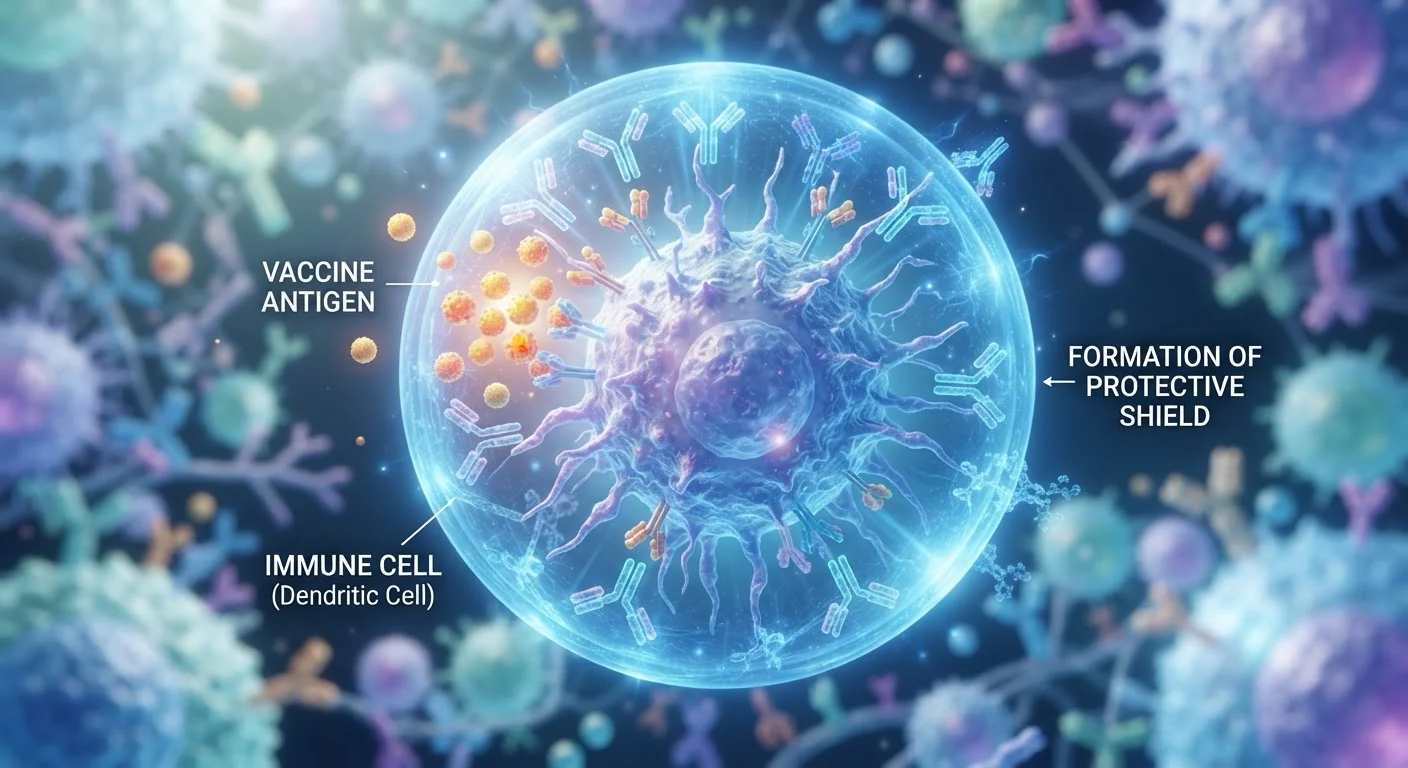
When a foreign substance — called an antigen — enters the body, specialized white blood cells called antigen-presenting cells break it down and display fragments of it. Helper T cells recognize these fragments and coordinate a broader response. B cells are activated to produce antibodies: proteins precisely shaped to bind to that specific antigen and neutralize or flag it for destruction. Cytotoxic T cells, meanwhile, learn to destroy any of your own cells that become infected.
After the initial threat clears, most of these activated cells die off — but a subset persists as memory cells. These long-lived cells are the foundation of lasting immunity. If the same antigen appears again, memory cells mount a response far faster and stronger than the first time, often neutralizing the pathogen before you develop any symptoms at all.
What Vaccines Actually Deliver
All vaccines share one goal: introduce an antigen — or the means to produce one — without causing disease. The platforms differ in how they do this.
- Live-attenuated vaccines (e.g., MMR, chickenpox) use a weakened form of the pathogen. They tend to generate strong, long-lasting immunity because the immune system's encounter closely mimics natural infection.
- Inactivated vaccines (e.g., flu shot, hepatitis A) use a killed version of the pathogen. They are very stable and safe, though sometimes require booster doses to maintain protection.
- Subunit vaccines (e.g., hepatitis B, whooping cough component in Tdap) deliver only specific proteins from the pathogen, triggering a targeted immune response with minimal components.
- mRNA vaccines (e.g., certain COVID-19 vaccines) instruct your cells to temporarily produce a harmless pathogen protein. Your immune system responds to that protein, builds memory, and the mRNA itself degrades within days.
Despite these differences in delivery, the downstream immune process is essentially the same: antigen recognition, B and T cell activation, antibody production, and memory cell formation.
2–3 million
Deaths prevented by vaccines annually
The World Health Organization estimates vaccines prevent 2–3 million deaths worldwide each year from diseases such as diphtheria, tetanus, pertussis, influenza, and measles.
~95%
Measles vaccine effectiveness after two doses
According to the CDC, two doses of the MMR vaccine are approximately 97% effective against measles, with a single dose providing around 93% protection.
Decades
Duration of memory cell protection for some vaccines
Research published in immunology journals shows that memory B and T cells generated by certain vaccines, such as MMR, can persist and provide measurable protection for 20 years or more.
From Individual Protection to Community Health
When enough people in a community are immune — through vaccination or prior infection — a pathogen struggles to find new hosts, which slows or halts its spread. This community-level effect offers a degree of protection even to those who cannot be vaccinated, such as newborns or people with certain immune conditions. Understanding the thresholds involved and why gaps can emerge is explored in depth in our article on herd immunity and its limits.
Individual vaccine decisions therefore carry a collective dimension. Maintaining high vaccination coverage according to CDC and ACIP schedules helps sustain protection across entire populations, not just the people who receive each dose.
Stay Current With Recommended Schedules
The CDC publishes vaccination schedules for children, adolescents, and adults that reflect current evidence on timing and dosing. Staying up to date — including recommended boosters — ensures your immune memory remains as strong as possible. Ask your primary care provider to review your vaccination history at your next routine visit.
Addressing Common Questions About Vaccine Safety
Mild side effects after vaccination — soreness at the injection site, fatigue, or a low-grade fever — are expected and generally short-lived. They reflect the immune system activating in response to the antigen, not an infection taking hold. Serious adverse events do occur but are rare; they are tracked through surveillance systems like the CDC's Vaccine Adverse Event Reporting System (VAERS) and the Vaccine Safety Datalink.
Regulatory approval requires vaccine manufacturers to demonstrate safety and efficacy through phased clinical trials. Post-authorization monitoring continues indefinitely. If you have specific concerns about a vaccine — particularly if you are pregnant, immunocompromised, have a history of severe allergies, or are making decisions for a child or older adult — discuss them with a qualified healthcare provider who can weigh your individual circumstances.
This article is for general informational purposes only and does not constitute medical advice. Always consult a licensed healthcare professional for guidance specific to your health situation.