

Key Takeaways
- Bodyweight training requires no equipment and builds real functional strength when progressed correctly.
- Free weights demand more coordination and stability, making them highly effective for building overall strength.
- Machines guide your movement path, lowering injury risk for beginners learning new exercise patterns.
- All three formats can produce meaningful strength and muscle gains when applied consistently.
- Most well-rounded routines combine elements from more than one training format.
Our Verdict
No single format wins outright - each offers a different set of trade-offs. Bodyweight training excels in accessibility and functional movement; free weights offer the greatest long-term strength potential; machines lower the barrier to entry for beginners and those returning from injury. The most durable fitness routines tend to draw from all three over time.
| Best for | Recommended |
|---|---|
| Those with no equipment or gym access | Bodyweight training |
| Those focused on building maximum strength and muscle | Free weights |
| Beginners learning movement patterns safely | Machines |
| Older adults or those managing joint concerns | Machines combined with bodyweight |
What Each Format Actually Is
Before comparing trade-offs, it helps to be precise about what each category means in practice.
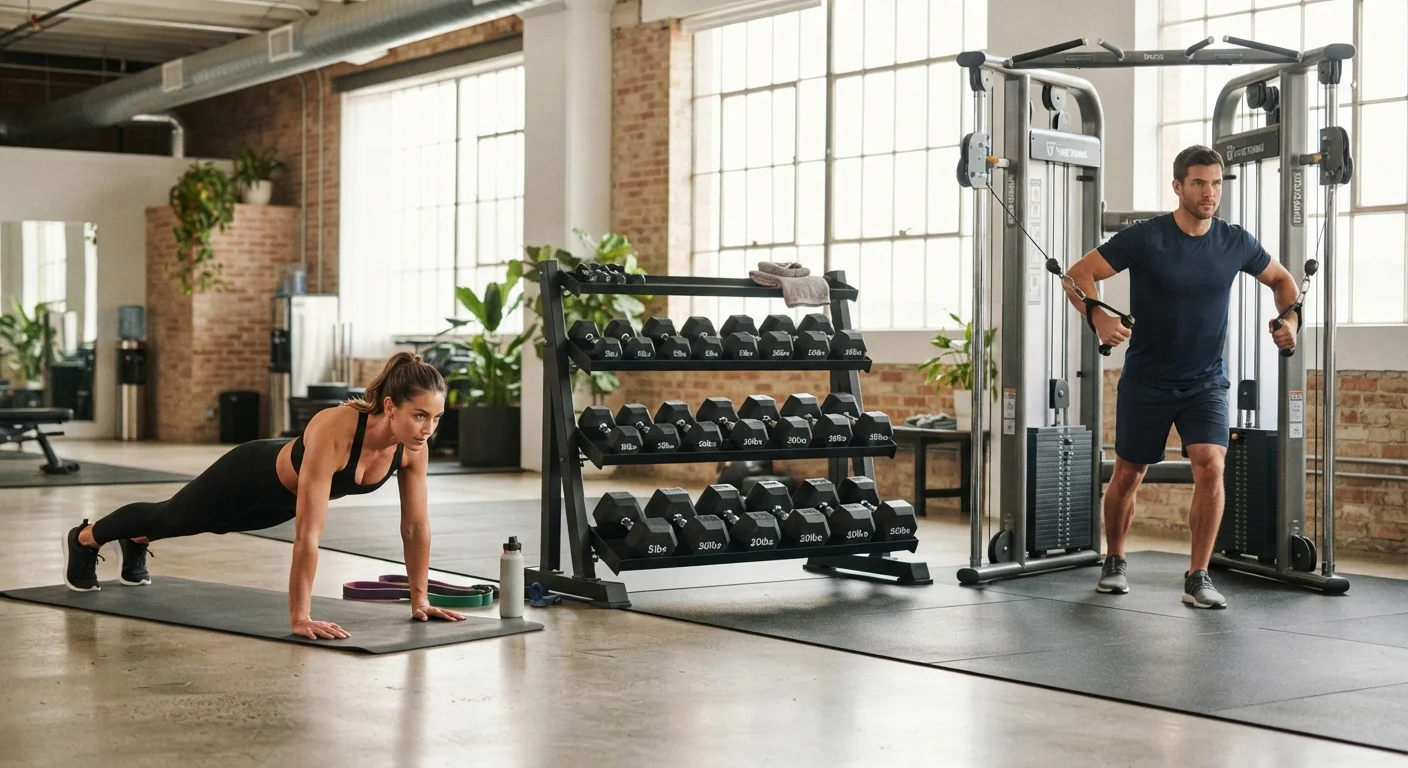
Bodyweight training uses your own mass as resistance - think push-ups, squats, lunges, and planks. No equipment needed, though rings and pull-up bars extend what's possible. Free weights include dumbbells, barbells, and kettlebells: implements you lift and control through space. Machines are fixed resistance devices - cable systems, plate-loaded machines, and selectorized stack machines - that guide your movement along a set path.
Each format creates mechanical tension in your muscles, which is the fundamental stimulus for building strength and muscle. The differences lie in how that tension is delivered, what skills are required, and how easily the resistance can be adjusted. For a broader look at how strength work fits into your overall routine, see how cardio and strength training compare.
Bodyweight Training: Accessible but Progressively Challenging
The strongest argument for bodyweight training is zero friction to start. There's no gym membership, no equipment cost, and no commute. Research supports bodyweight exercises as effective for improving muscular endurance, movement quality, and baseline strength - particularly in untrained individuals.
The limitation is progressive overload. Adding resistance to a barbell is straightforward; making a push-up meaningfully harder requires skill - elevating the feet, slowing the tempo, moving to archer push-ups, or eventually one-arm variations. That progression is learnable, but it requires more creativity and patience than simply adding weight to a bar.
Bodyweight training also develops proprioception (your body's sense of its own position in space) and functional mobility, since you're rarely locked into a fixed movement path. For people training at home, it's a natural starting point. Working out at home vs. at a gym covers how environment shapes what's realistic.
Progressing Bodyweight Exercises Effectively
To keep bodyweight training challenging as you grow stronger, manipulate leverage, tempo, or range of motion rather than just adding reps. Slowing the lowering phase of a push-up to three or four seconds, for example, increases muscle tension significantly without requiring any equipment. Small adjustments in body angle or limb position can also change the difficulty considerably.
Free Weights: High Reward, Higher Skill Demand
Free weights are broadly considered the most versatile and scalable resistance training tool. Because the weight moves freely through space, your muscles must stabilize the load in addition to moving it - recruiting more muscle fiber across more joints. This is why compound free-weight exercises like deadlifts, rows, and overhead presses are mainstays of serious strength programming.
The trade-off is a steeper learning curve. Poor technique under load increases injury risk, which means beginners benefit from qualified instruction before adding significant weight. Form matters more here than in either of the other formats.
Free weights also scale indefinitely: a 5-pound dumbbell and a 100-pound barbell operate on the same principle, making this format suitable from beginner to advanced. If you want to build strength over months and years, free weights tend to offer the clearest path - particularly if you're willing to invest time in learning movement quality first. Common fitness myths may also be worth addressing before you start.
| Bodyweight | Free Weights | Machines | |
|---|---|---|---|
| Equipment cost | None required | Moderate to high | High (gym access) |
| Skill/technique demand | Low to moderate | Moderate to high | Low |
| Scalability over time | Requires creativity | Excellent, unlimited | Limited by machine range |
| Stability/coordination required | Moderate | High | Low |
| Muscle isolation | Difficult | Moderate | Excellent |
| Beginner friendliness | High | Moderate | High |
| Access anywhere | Yes | Mostly gym-based | Gym only |
Machines: Structured, Safe, and Underrated
Machines are often dismissed as beginner tools, but that framing is misleading. Their guided movement path reduces the coordination demand, which means you can load a muscle more directly and with less technique overhead. This makes them genuinely valuable for beginners learning what a controlled squat or row feels like, for people rehabilitating an injury under clinical supervision, and for trained lifters isolating specific muscles at the end of a workout.
The fixed path can also be a limitation: machines are designed for average body proportions, and if your limb lengths or joint angles don't match the machine's geometry, you may experience discomfort or compensate in ways that undermine the exercise. Not every machine fits every body well.
For older adults beginning a strength routine, machines offer a lower-risk entry point. Strength training for adults in their 60s and beyond covers how to approach this safely. Machines aren't a lesser option - they're a different tool.
This article is for general informational and educational purposes only, and is not a substitute for professional medical or fitness advice. Consult a qualified healthcare or fitness professional before beginning any new exercise program, especially if you have an existing health condition or injury.