

Key Takeaways
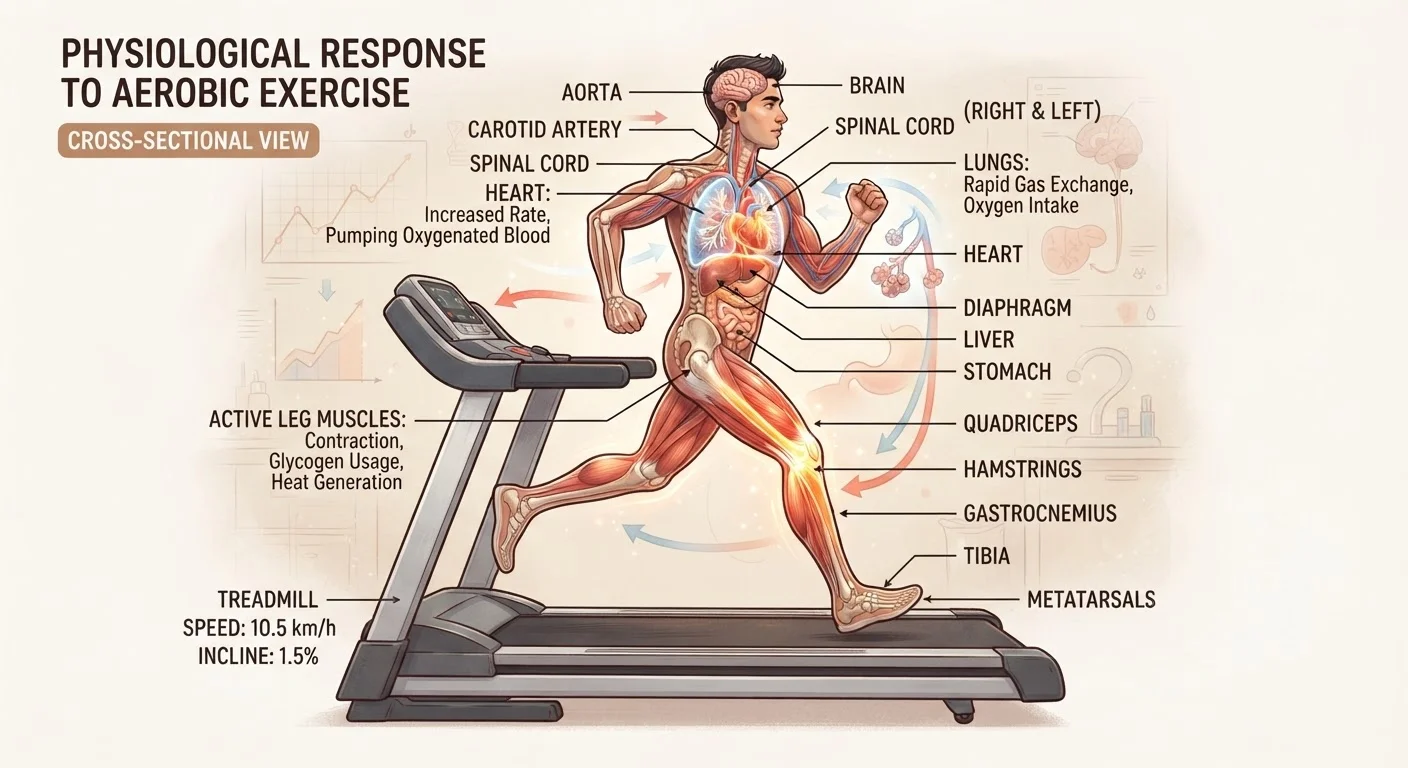
- Your heart rate rises within seconds of starting exercise to increase blood flow to working muscles.
- Muscles switch between energy systems depending on how intense and how long you work out.
- Breathing rate increases to bring in more oxygen and expel carbon dioxide more efficiently.
- Hormones like adrenaline and cortisol are released to mobilize fuel and keep you alert.
- Even a single session creates temporary changes that, over time, build lasting fitness adaptations.
- Soreness after exercise is a normal part of the repair process, not a sign of injury.
Exercise Physiology
Exercise physiology is the study of how the body responds and adapts to physical activity. When you exercise, your muscles, heart, lungs, hormones, and nervous system all shift into a coordinated response to meet increased energy demands. Understanding these processes helps explain why consistent movement produces lasting improvements in health and fitness.
Acute exercise responses (what happens during a single session) are distinct from chronic adaptations (long-term structural and functional changes from repeated training). This article focuses on the acute response.
The First 60 Seconds: Your Body Shifts into Gear
The moment you start moving with intention, your body launches a rapid, coordinated response. Your nervous system signals the adrenal glands to release epinephrine (adrenaline), which causes your heart to beat faster and your airways to widen. Blood is rerouted away from non-essential organs and directed toward your working muscles — a process called vasodilation.
Your muscles begin drawing on stored adenosine triphosphate (ATP), the molecule that powers every muscular contraction. Because ATP stores are small, your body quickly moves to replenish them. For short, intense bursts, it uses the phosphocreatine system, which provides rapid energy without requiring oxygen. For sustained effort, it shifts to burning carbohydrates and fats through aerobic metabolism.
Before your first workout, it helps to understand what you're stepping into. Preparing properly — hydration, warm-up, and knowing what to expect — makes this initial physiological shift much more comfortable.
Your Heart and Lungs: Working in Concert
Cardiovascular and respiratory responses are among the most immediately noticeable changes during exercise. Your heart rate can double or even triple from resting levels, depending on exercise intensity. Alongside this, stroke volume — the amount of blood pumped per heartbeat — also increases, dramatically raising total cardiac output.
Your lungs respond in parallel. Breathing rate rises, and each breath becomes deeper, pulling in more oxygen and expelling more carbon dioxide. At higher intensities, breathing may shift from being automatically regulated to feeling effortful and conscious — a sign that your body is working hard to maintain gas exchange.
4–6x
Increase in cardiac output during vigorous exercise
Cardiac output — heart rate multiplied by stroke volume — can rise from roughly 5 liters per minute at rest to 20–30 liters per minute during intense aerobic effort, according to established exercise physiology research.
15x
Increase in oxygen consumption at peak exercise
Well-trained individuals can increase their oxygen uptake up to 15 times above resting levels during maximal effort, reflecting the efficiency gains that come with regular aerobic training.
~70%
Energy lost as heat during muscle contractions
Human muscles are roughly 25–30% efficient at converting chemical energy into mechanical work; the remaining energy is released as heat, which is why core body temperature rises during exercise.
These cardiovascular adaptations are precisely why consistent training gradually lowers resting heart rate and improves endurance. Your heart becomes more efficient over time — a core benefit of aerobic exercise. To understand how different workout types drive different cardiovascular adaptations, see the major types of exercise and what each does.
Muscles, Fuel, and the Heat Your Body Generates
Muscle fibers are recruited in an orderly way as demand increases. Slow-twitch fibers — efficient and fatigue-resistant — are engaged first. As intensity rises, fast-twitch fibers join in to produce greater force. This is why a brisk walk feels manageable while an all-out sprint feels challenging within seconds.
Fueling these contractions requires a steady supply of glucose and fatty acids. At lower intensities, fat is the primary fuel source. As effort escalates, your body relies more heavily on carbohydrates for faster energy conversion. This is why glycogen stores — carbohydrate stored in muscles and the liver — matter so much for sustained high-effort activity.
“Exercise is the single best thing you can do for your brain in terms of mood, memory, and learning. Even 20 minutes of activity has measurable effects on brain chemistry and cognition.”
— John Ratey, Associate Clinical Professor of Psychiatry, Harvard Medical School, and author of 'Spark: The Revolutionary New Science of Exercise and the Brain'
Heat is a byproduct of this metabolic activity. Your core temperature rises, and your body responds by increasing blood flow to the skin and activating sweat glands to release heat through evaporation. Staying hydrated supports this cooling process and helps maintain performance.
After the Session: Where Recovery Begins
Even as you cool down, the body's response continues. Heart rate gradually returns to resting levels, breathing slows, and hormones that surged during exercise begin to taper. But the work isn't finished — your body now shifts into repair and adaptation mode.
Muscle fibers that experienced stress during exercise undergo microscopic damage that triggers a rebuilding process. This is the mechanism behind strength gains. Glycogen stores are replenished from carbohydrates consumed after training. What you eat after a workout can meaningfully influence how efficiently this happens.
For a deeper look at what occurs inside muscle tissue in the hours and days following training, see our article on the science of muscle repair. Understanding recovery is just as important as understanding the workout itself — both are part of the same physiological loop.
This article is for informational purposes only and is not a substitute for personalized medical or fitness advice. Consult a qualified healthcare professional before beginning a new exercise program, especially if you have an existing health condition.