

Key Takeaways
- Increased intestinal permeability is a measurable, real phenomenon — but it is not a standalone diagnosis.
- No test can definitively diagnose 'leaky gut syndrome' as a clinical condition at present.
- Certain diseases are associated with elevated intestinal permeability, but causality is often unclear.
- Many supplements marketed for leaky gut lack robust clinical evidence to support their claims.
- Diet, sleep, stress management, and avoiding excess alcohol support a healthy gut lining over time.
What Intestinal Permeability Actually Is
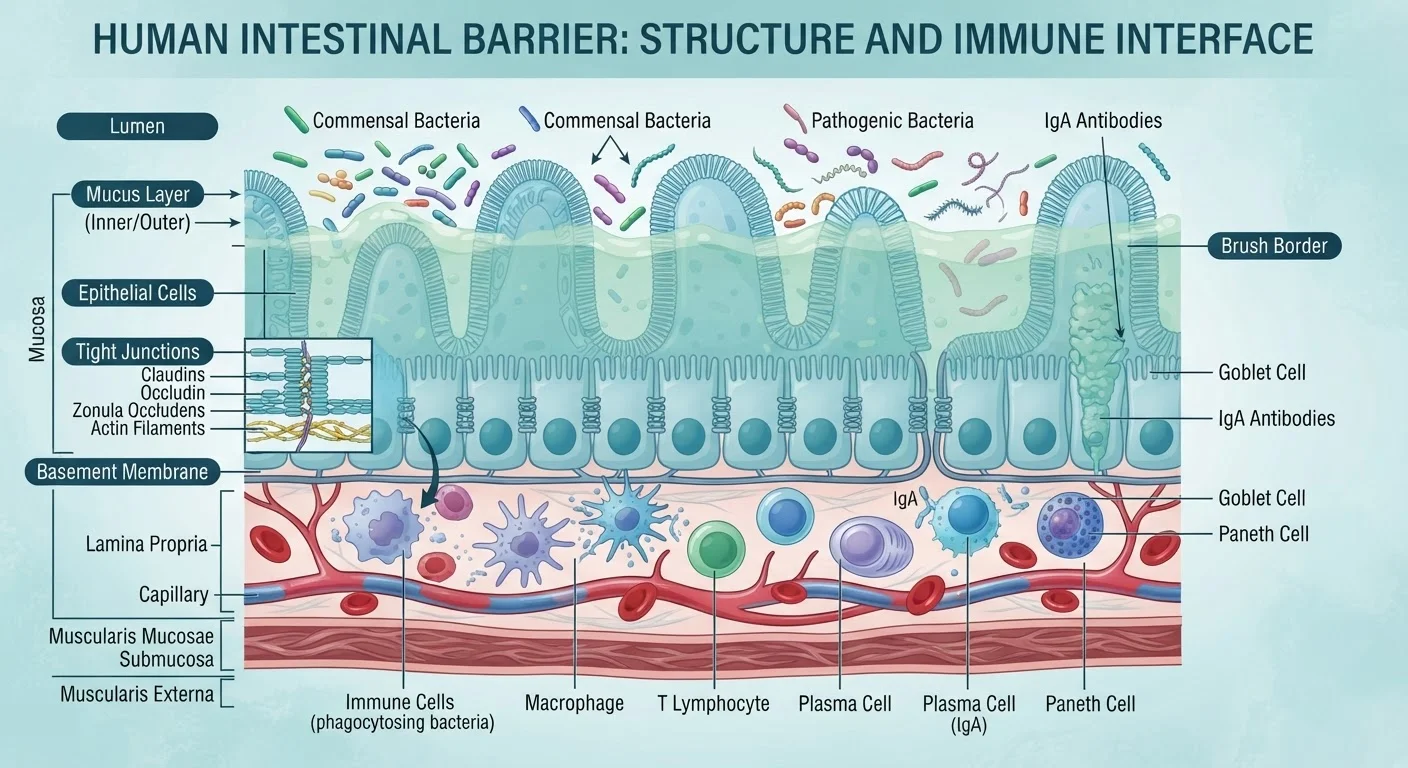
Your gut lining — a single layer of epithelial cells spanning the length of the small and large intestine — is simultaneously a passageway and a gatekeeper. It allows nutrients, water, and beneficial molecules to cross into the bloodstream while blocking harmful bacteria, undigested food particles, and bacterial toxins. The seals between those cells, called tight junctions, are not rigid walls; they are dynamic, responsive structures regulated by the nervous system, immune signals, and the microbiome itself.
When tight junctions become dysregulated, permeability increases. This is not inherently catastrophic — some degree of permeability fluctuation is normal. The concern arises when the barrier is persistently compromised, allowing substances to cross that should not. Understanding this nuance is the starting point for cutting through the noise around "leaky gut." For foundational context on how the gut and immune system interact, the gut microbiome and immune function beginner's roadmap is a useful starting point.
Myth
"Leaky gut syndrome" is a well-recognized medical diagnosis that doctors routinely test for and treat.
Fact
Increased intestinal permeability is a measurable physiological state, but "leaky gut syndrome" is not a recognized clinical diagnosis in conventional medicine.
The intestinal lining relies on structures called tight junctions — proteins that seal the gaps between epithelial cells and control what passes into the bloodstream. When those junctions loosen, the barrier becomes more permeable. Researchers can measure this using tools such as the lactulose-mannitol test or serum zonulin levels.
However, increased permeability is a feature found in association with several conditions — including celiac disease, Crohn's disease, and irritable bowel syndrome — not a disease in itself. The term "leaky gut syndrome," as widely used online, implies a single diagnosable illness with a discrete treatment, which is not how mainstream gastroenterology currently frames it. For a fuller explainer, see what leaky gut actually means.
Myth
A leaky gut directly causes autoimmune diseases by letting toxins flood the body.
Fact
The relationship between intestinal permeability and autoimmunity is an active research area, but cause-and-effect has not been firmly established in humans.
Animal studies and some human observational data suggest that a compromised gut barrier may allow bacterial fragments — such as lipopolysaccharides (LPS) — to enter circulation, potentially provoking immune responses. Elevated permeability has been documented in conditions like type 1 diabetes and rheumatoid arthritis.
But observing that two things co-occur is not the same as proving one causes the other. It is equally plausible that the underlying inflammatory process damages the gut lining, rather than the reverse. Scientists are actively untangling this chicken-and-egg question. Overstating the evidence — as much popular content does — can lead people to pursue unproven treatments instead of evidence-based care.
Myth
Expensive supplements labeled "gut repair" or "intestinal support" reliably fix a leaky gut.
Fact
Most supplements marketed for leaky gut have limited or preliminary human clinical evidence; none have been approved by the FDA to treat intestinal permeability.
Ingredients like L-glutamine, collagen peptides, and zinc carnosine are frequently promoted for gut lining support. Some show modest promise in early research — for example, zinc has demonstrated roles in maintaining tight junction integrity in certain contexts — but large, well-controlled clinical trials in humans are generally lacking.
Dietary supplements in the U.S. are not required to prove efficacy before reaching store shelves. This means a product can claim to "support gut health" without any obligation to demonstrate it works. Anyone considering these products should discuss them with a qualified healthcare provider rather than relying on marketing language alone.
Myth
If your gut is "leaky," you will feel obvious symptoms like bloating or fatigue that clearly signal the problem.
Fact
Increased intestinal permeability often produces no obvious symptoms on its own and cannot be self-diagnosed from general symptoms.
Bloating, fatigue, brain fog, and skin issues are extremely common and have many possible causes. Attributing them automatically to leaky gut — without clinical evaluation — risks missing other explanations, including thyroid dysfunction, food intolerances, sleep disorders, or mood conditions.
This is one reason the gut-immune field cautions against self-diagnosis. The symptoms overlap with dozens of conditions, and the only way to meaningfully assess gut barrier function is through validated clinical or research tools, not symptom checklists found on wellness websites. For a broader look at gut-immune misconceptions, see common gut-immune myths.
Myth
Gluten causes leaky gut in everyone, not just people with celiac disease.
Fact
In people without celiac disease or confirmed non-celiac gluten sensitivity, evidence that gluten meaningfully increases intestinal permeability is weak.
In celiac disease, the immune response to gliadin (a gluten protein) does demonstrably disrupt tight junctions and increase permeability. Research by Alessio Fasano and colleagues identified zonulin — a protein that modulates tight junctions — as part of this pathway.
However, extrapolating from celiac disease to the general population requires caution. Studies in people without celiac disease have not consistently shown that gluten consumption significantly impairs gut barrier function. Eliminating gluten unnecessarily can reduce dietary fiber diversity, which may negatively affect the microbiome. Individuals concerned about gluten should be evaluated by a clinician before making major dietary changes.
What the Evidence Does — and Doesn't — Support
Intestinal permeability research is genuinely exciting and rapidly evolving. Studies have linked elevated permeability to conditions including celiac disease, inflammatory bowel disease, and certain liver conditions. The gut-immune axis — the bidirectional communication network between gut microbes, the intestinal lining, and the immune system — is one of the most active areas of biomedical research today, and for good reason. As explained in our piece on what it means that your gut houses most of your immune system, the immune tissue concentrated in the gut is substantial and consequential.
What the evidence does not yet support is the popular wellness narrative that leaky gut is a universal root cause of chronic illness, or that it can be fixed with a targeted supplement protocol. The science is promising but preliminary in many areas. Readers deserve to know that distinction.
Do Not Self-Diagnose or Self-Treat
If you are experiencing persistent digestive symptoms, fatigue, or other chronic complaints, please consult a licensed healthcare provider. Attributing your symptoms to leaky gut without a clinical evaluation can delay identification of conditions that require proper diagnosis and treatment. No supplement or elimination diet should replace professional medical assessment.
Practical steps with solid general evidence behind them include eating a fiber-rich, varied diet to support microbial diversity, limiting excess alcohol (a known disruptor of tight junctions), managing chronic stress, and prioritizing sleep. These are not cures for any specific condition — they are reasonable ways to support overall gut barrier and immune function. Always consult a healthcare professional for symptoms that concern you.
This article is for general informational purposes only and does not constitute medical advice. Always consult a qualified healthcare professional before making changes to your diet, supplement regimen, or health care.