

| Immune Tissue in the Gut | ~70% of the body's immune cells (Widely cited estimate in immunology literature) |
| Estimated Gut Microbiome Species | 500–1,000+ bacterial species (Human Microbiome Project and related research) |
| Gut Surface Area | ~32 square meters (tennis court-sized) (Anatomical estimates vary; ~32 m² is a commonly cited figure) |
| Primary Immune Function Site | Gut-Associated Lymphoid Tissue (GALT) (Standard immunology reference) |
| Main Fiber Fermentation Byproducts | Short-chain fatty acids (SCFAs) (Established microbiome research) |
Why the Gut-Immune Axis Matters
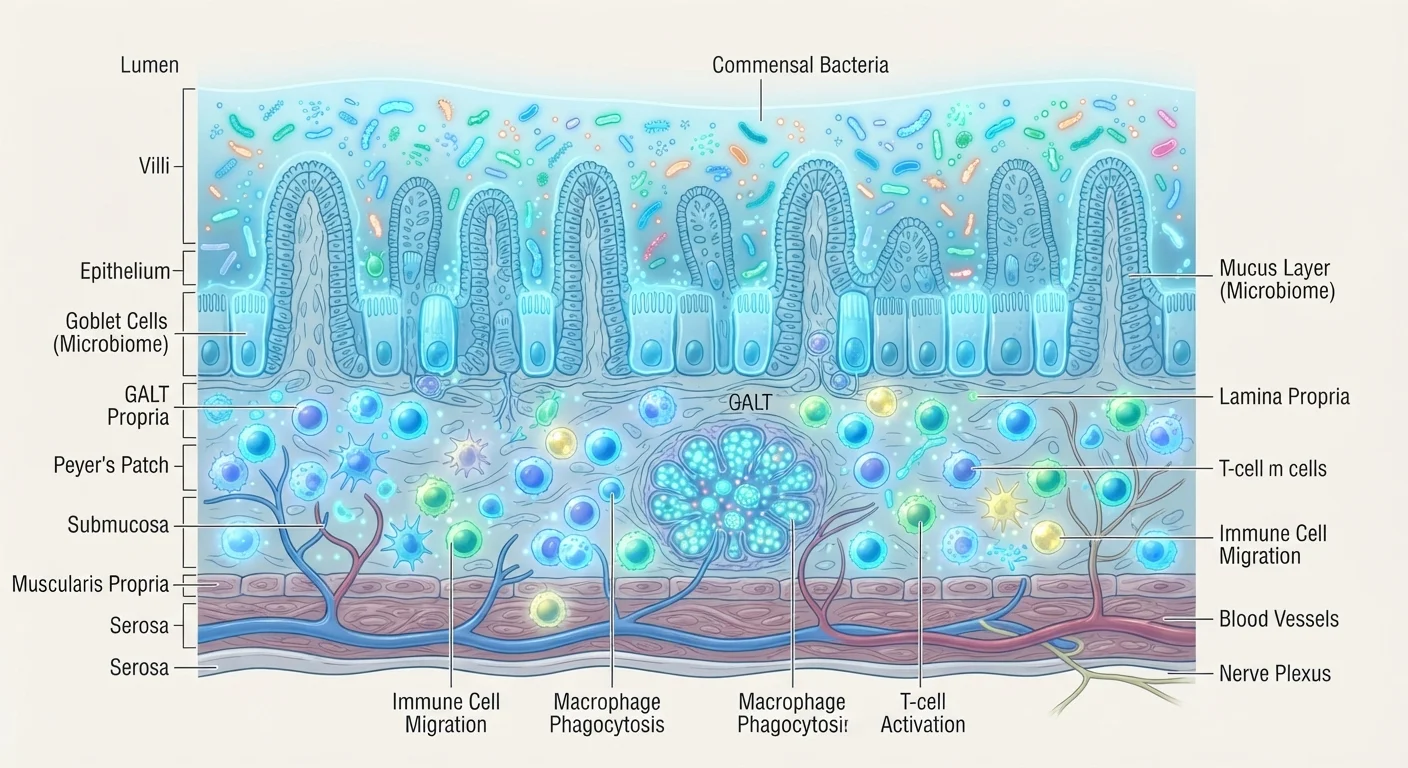
Roughly 70 percent of the body's immune tissue resides in and around the gastrointestinal tract — a fact that surprises many people who think of digestion and immunity as separate systems. They are not. The gut and the immune system form a tightly integrated axis, with each influencing the other's activity in real time.
Understanding the vocabulary of this relationship is genuinely useful. When you read about probiotics, leaky gut, or mucosal immunity, you are encountering terms that describe real biological mechanisms — not marketing abstractions. This guide defines those terms clearly, so you can read health information more critically and have more informed conversations with your healthcare provider.
For a broader grounding in digestive function and microbiome balance, the Gut Health Basics hub is a strong starting point.
| Immune Tissue in the Gut | ~70% of the body's immune cells (Widely cited estimate in immunology literature) |
| Estimated Gut Microbiome Species | 500–1,000+ bacterial species (Human Microbiome Project and related research) |
| Gut Surface Area | ~32 square meters (tennis court-sized) (Anatomical estimates vary; ~32 m² is a commonly cited figure) |
| Primary Immune Function Site | Gut-Associated Lymphoid Tissue (GALT) (Standard immunology reference) |
| Main Fiber Fermentation Byproducts | Short-chain fatty acids (SCFAs) (Established microbiome research) |
Core Terms Defined
The glossary below covers the most important concepts across four areas: the microbiome, the gut barrier, immune cells and signaling, and dysbiosis. Each definition is written for general readers — no medical training required.
Gut Microbiome
The collective community of trillions of microorganisms — bacteria, fungi, viruses, and other microbes — that inhabit the gastrointestinal tract. This ecosystem plays a central role in digestion, immune education, and metabolic regulation.
Gut-Immune Axis
The bidirectional communication network between the gastrointestinal tract and the immune system. Signals flow both ways: gut microbes influence immune cell development and tolerance, while immune activity shapes which microbes can thrive.
Mucosal Immunity
The immune defenses operating at mucosal surfaces — including the gut lining — that form the body's first line of defense against pathogens. Secretory IgA antibodies are a key component, neutralizing harmful microbes before they penetrate deeper tissue.
Gut-Associated Lymphoid Tissue (GALT)
A large collection of immune tissue embedded in the gut wall, including Peyer's patches and mesenteric lymph nodes. GALT is where the immune system constantly samples gut contents to distinguish harmless substances from genuine threats.
Dysbiosis
An imbalance in the composition or function of the gut microbiome, often characterized by reduced microbial diversity or overgrowth of potentially harmful species. Dysbiosis has been associated with conditions ranging from inflammatory bowel disease to metabolic disorders.
Intestinal Permeability
A measure of how easily substances pass through the gut lining into the bloodstream. Increased permeability — sometimes called 'leaky gut' — may allow bacterial fragments to trigger systemic immune responses, though the clinical significance is still an active area of research.
Tight Junctions
Protein structures that seal the gaps between intestinal epithelial cells, controlling what passes from the gut into the body. Their integrity is essential for maintaining an effective gut barrier.
Short-Chain Fatty Acids (SCFAs)
Metabolites produced when gut bacteria ferment dietary fiber. Butyrate, acetate, and propionate are the main SCFAs; they nourish intestinal cells, support regulatory immune responses, and help maintain gut barrier function.
Probiotics
Live microorganisms that, when consumed in adequate amounts, may confer a health benefit to the host. Effects are highly strain-specific, meaning different bacterial strains have different — and not interchangeable — biological actions.
Prebiotics
Non-digestible food components, primarily dietary fibers, that selectively feed beneficial gut bacteria. Common examples include inulin and fructooligosaccharides found naturally in garlic, onions, and chicory root.
Regulatory T Cells (Tregs)
A subset of immune cells that suppress excessive immune responses and promote tolerance to harmless substances, including food proteins and commensal microbes. Gut microbiota play an important role in shaping Treg development.
Secretory IgA (sIgA)
The predominant antibody found in the gut's mucosal layer. It binds to pathogens and foreign particles, preventing them from adhering to intestinal cells and crossing into the body.
For a deeper look at how microbial imbalance specifically drives inflammation, see our companion article Gut Bacteria, Inflammation, and Immunity: The Science Simplified.
Key Statistics That Put the Science in Context
Numbers can anchor abstract biology in something more tangible. The figures below reflect well-established estimates from published research and help illustrate just how central the gut is to immune function.
~70%
Of immune cells located in the gut
A widely cited estimate in immunology literature underscoring the gut's central role in systemic immunity.
500–1,000+
Bacterial species in a healthy gut microbiome
According to findings from the Human Microbiome Project and subsequent large-scale sequencing studies.
~23 feet
Length of the human small intestine
This extensive surface is lined with immune-sensing tissue, making it the body's largest interface with the external environment.
3 main SCFAs
Short-chain fatty acids produced by fiber fermentation
Butyrate, acetate, and propionate are produced by gut bacteria and are integral to gut barrier health and immune regulation.
These figures underscore why gut health research has become one of the most active areas of biomedical science. Disruptions in this system — from antibiotic overuse, poor diet, or chronic stress — can have measurable downstream effects on immune regulation.
For a comprehensive end-to-end overview, Gut Health From Every Angle covers core concepts that connect the dots between microbiome diversity and immune outcomes.
Applying This Knowledge Day to Day
Reference knowledge becomes most valuable when it supports real decisions. Here is how several key concepts translate into everyday health awareness:
- Microbiome diversity is supported by dietary variety — particularly fiber-rich vegetables, legumes, and fermented foods. No single food guarantees a healthy microbiome.
- Gut barrier integrity can be affected by chronic alcohol use, nonsteroidal anti-inflammatory drugs (NSAIDs), and prolonged psychological stress. These are modifiable risk factors worth discussing with a clinician.
- Dysbiosis is not something you can reliably self-diagnose. Commercial microbiome tests exist, but their clinical utility remains limited and contested in current research.
- Probiotics and prebiotics are widely studied, but their effects are strain- and context-specific. If you are considering supplements, consult a healthcare professional — especially if you have an underlying condition or are immunocompromised.
If you encounter unfamiliar terms on food or supplement packaging, Reading a Gut Health Claim offers a practical field guide to common label language.
This article is for general informational and educational purposes only and is not a substitute for professional medical advice, diagnosis, or treatment. Always consult a qualified healthcare provider with questions about your health or before making changes to your diet, supplement routine, or medical care.