

Key Takeaways
- Falls are the leading cause of injury-related death among adults 65 and older, but many are preventable.
- Balance training programs with specific, targeted exercises have strong research support for reducing fall risk.
- Exercises like tai chi, single-leg standing, and heel-to-toe walking address the core contributors to instability.
- Consistency and progressive challenge — not intensity — are the keys to lasting improvement.
- Always consult a healthcare provider before starting a new balance or exercise program, especially after a fall.
Why Balance Declines — and Why It Matters
Each year, roughly one in four adults over age 65 experiences a fall, according to the Centers for Disease Control and Prevention. Falls are the leading cause of injury-related death in this population, and fear of falling can itself become a barrier to activity — compounding the problem by reducing the very movement that maintains stability.
Balance depends on an integrated system: vision, vestibular (inner ear) signals, and proprioception — the body's sense of where its limbs are in space. All three systems become less reliable with age, and the muscles that make quick corrective adjustments also lose strength and speed. The encouraging news is that all of these factors are trainable. Well-designed balance programs don't just slow decline; they actively rebuild functional stability.
Research consistently shows that targeted balance training can reduce fall frequency by roughly 23–30% in community-dwelling older adults. That's a meaningful reduction — and it's achievable through exercises that require no special equipment and can be done at home.
~23–30%
Reduction in falls from balance training
Multiple systematic reviews, including Cochrane analyses, have found targeted balance exercise programs reduce fall rates by roughly this margin in older community-dwelling adults.
1 in 4
Older adults who fall each year
The CDC reports that approximately one in four adults aged 65 and older experiences a fall annually in the United States.
Evidence-Backed Balance Exercises to Practice
The following practices are grounded in clinical research and widely recommended by physical therapists and public health guidelines. Each targets one or more of the physical systems that underlie safe, stable movement.
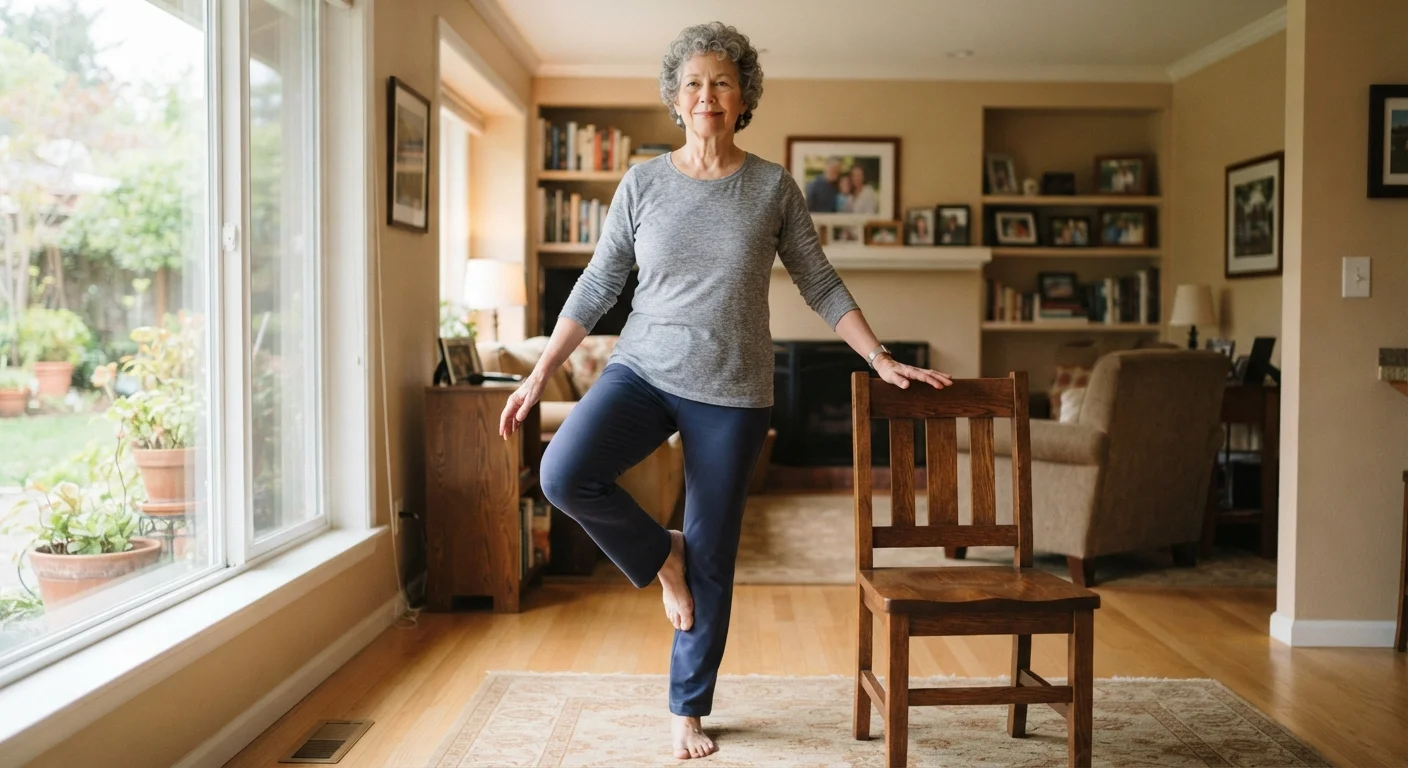
Practice single-leg standing daily, using a sturdy chair for support as needed.
Standing on one leg directly trains the stabilizer muscles in the ankle, knee, and hip — the same muscles that fire when you catch yourself from a stumble. Even brief daily practice has been shown to improve balance scores in older adults within weeks.
Incorporate tai chi classes or a structured tai chi video program at least twice per week.
Tai chi is one of the most extensively studied interventions for fall prevention. Multiple randomized trials and systematic reviews — including work synthesized by the Cochrane Collaboration — have found it significantly reduces fall rates in older adults, likely because it trains slow, controlled weight shifting and postural awareness simultaneously.
Walk heel-to-toe in a straight line — known as tandem walking — for short distances each day.
Tandem walking narrows the base of support, forcing the body to make continuous small balance corrections. It directly challenges the vestibular and proprioceptive systems and builds confidence walking on uneven surfaces.
Add calf raises to your daily routine to strengthen the ankle stabilizers.
Ankle weakness is a common and underappreciated contributor to falls. Calf raises strengthen the gastrocnemius and soleus muscles, which play a critical role in maintaining upright posture and absorbing forces during walking.
Include seated leg strengthening exercises to build the quadriceps and hip extensors.
Strong legs are the foundation of good balance. The quadriceps, in particular, control how quickly and steadily a person can sit down, stand up, and recover from a stumble. Seated exercises allow progressive loading with minimal fall risk during the exercise itself.
For readers interested in pairing balance work with broader physical activity, low-impact activities that deliver real fitness gains can complement a balance routine without adding joint stress.
Building a Routine That Sticks
The most effective balance exercise is the one done consistently. Research on exercise adherence in older adults points to a few reliable strategies: short sessions integrated into daily life, visible progress markers, and starting well within your current ability to avoid discouragement or injury.
Many older adults mistakenly believe that decline in physical function is simply inevitable. Common beliefs about aging and exercise that physiology doesn't support challenges that assumption with evidence. Similarly, physical activity guidelines for older adults clarify how balance training fits into a broader weekly movement goal.
Progress Gradually to Avoid Injury
Always begin balance exercises with a stable support nearby — a chair back, a countertop, or a wall — and remove it only when you feel genuinely confident. Rushing to remove support before you're ready increases, not decreases, fall risk during practice. A physical therapist can help you identify the right starting point and progression pace for your individual fitness level.
This article is for general informational and educational purposes only. It is not a substitute for professional medical advice, diagnosis, or treatment. If you have a history of falls, a chronic condition, or any concerns about your balance, consult your physician or a licensed physical therapist before beginning a new exercise program.