

Key Takeaways
- Low-impact exercise can improve cardiovascular fitness, muscle strength, and balance without high joint stress.
- Activities like swimming, tai chi, and cycling address multiple fitness dimensions simultaneously.
- Consistency and variety matter more than intensity for long-term health gains in older adults.
- Many low-impact options are accessible to people managing arthritis, limited mobility, or chronic conditions.
- Always consult a healthcare provider before beginning or significantly changing an exercise routine.
Why Low-Impact Doesn't Mean Low-Results
There's a persistent assumption that exercise only counts if it's strenuous — that aging adults need to push hard or stay home. Physiology tells a different story. Research consistently shows that moderate, low-impact movement produces meaningful gains in cardiovascular capacity, muscular strength, bone density, and balance, all without the injury risk that accompanies high-impact training.
This matters because joint health often becomes a limiting factor as we age. Cartilage thins, recovery slows, and repetitive impact stress can sideline even motivated exercisers. Low-impact activities reduce ground-reaction forces on knees, hips, and the lower spine while still challenging the cardiovascular system and musculature in ways that drive adaptation. For a broader look at what movement can realistically achieve across the decades, see the complete active aging guide.
The activities below are selected because each one delivers documented, multi-dimensional benefits — not just a gentle walk for its own sake. They can be combined, scaled, and adapted to a wide range of starting fitness levels.
Swimming and Water Aerobics
Water-based exercise is one of the most joint-friendly options available. Buoyancy reduces effective body weight by up to 90 percent when submerged to the neck, dramatically decreasing compressive forces on hips, knees, and the spine. At the same time, water provides resistance in all directions, meaning muscles work harder to move through it than they would through air.
Swimming laps builds cardiovascular endurance and engages nearly every major muscle group. Water aerobics classes offer a more structured, social alternative with similar benefits. Both have shown promise in studies examining mobility and pain management in people with osteoarthritis, making them a natural fit for those navigating joint conditions. See staying active with arthritis for more detail on movement and joint health.
Buoyancy can reduce effective body weight by up to 90 percent, making water exercise uniquely gentle on joints.
Tai Chi
Tai chi is a slow, deliberate movement practice rooted in Chinese martial arts tradition. Its structured sequences of flowing postures challenge balance, coordination, lower-body strength, and flexibility simultaneously — a rare combination for a single activity.
Among older adults, tai chi has a particularly strong evidence base for fall prevention. A body of research, including work published in prominent journals of aging and geriatrics, links regular tai chi practice to measurable improvements in static and dynamic balance. It also appears to support psychological well-being, with participants frequently reporting reduced anxiety and improved sleep quality. For those interested specifically in fall prevention strategies, balance exercises that reduce fall risk covers the evidence in detail.
Tai chi's evidence base for fall prevention in older adults is among the strongest of any single physical activity.
Cycling (Stationary or Outdoor)
Cycling — whether on a stationary bike, a recumbent bike, or a standard road bicycle — provides meaningful cardiovascular conditioning while keeping impact on weight-bearing joints minimal. The seated position transfers much of the body's load to the saddle, sparing the knees and hips from the repetitive ground-strike forces associated with walking or jogging.
Stationary bikes offer the added advantage of stability, which can be important for those with balance concerns. Recumbent bikes distribute weight more evenly and can be more comfortable for people with lower back issues. For a comparison of cycling against other common cardio options, walking, swimming, or cycling for older adults weighs the tradeoffs directly.
Cycling delivers serious cardiovascular conditioning while sparing knees and hips from repetitive impact stress.
Resistance Band Training
Maintaining muscle mass is one of the most consequential fitness goals for older adults. Skeletal muscle naturally declines with age — a process called sarcopenia — and insufficient muscle mass is associated with falls, reduced mobility, and metabolic disruption. Resistance bands offer a practical, low-impact way to counter this decline.
Bands accommodate a wide range of resistance levels and can be used seated, standing, or lying down, making them adaptable to nearly any mobility level. Unlike free weights or machines, bands provide variable resistance — tension increases as the band stretches — which can be easier on joints while still stimulating muscle adaptation. For those curious about how resistance training changes across decades of life, strength training after 40 provides helpful physiological context.
Resistance bands offer a joint-friendly way to build muscle and counter the natural decline of sarcopenia.
Yoga (Chair or Floor-Based)
Yoga improves flexibility, joint range of motion, core stability, and body awareness — all of which tend to erode with age and inactivity. Chair yoga adapts traditional poses to a seated or standing-with-support format, making the practice accessible to those who cannot easily get up and down from the floor.
Floor-based yoga classes designed for older adults typically emphasize restorative poses, breath work, and controlled stretching rather than advanced balancing postures. The emphasis on mindful movement and breath has also shown associations with reduced cortisol levels and improved stress regulation in some research populations. For a deeper look at why flexibility and mobility deserve a dedicated place in an older adult's routine, the role of flexibility and mobility in healthy aging offers a focused analysis.
Chair yoga makes the flexibility and mindfulness benefits of yoga accessible regardless of mobility limitations.
Walking With Intention
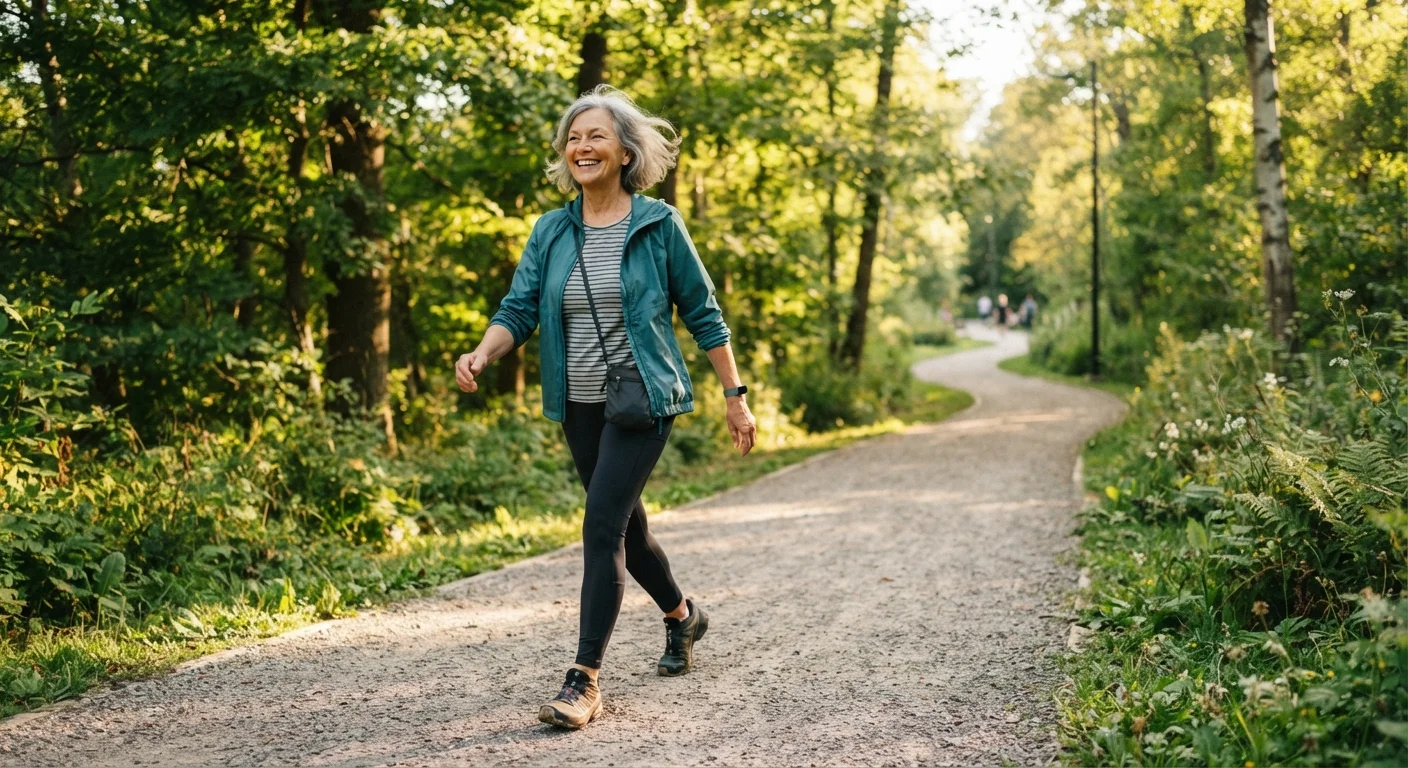
Walking is the most common form of physical activity among older Americans — and often underestimated. When approached with intention — including variations in pace, terrain, and duration — walking can deliver genuine cardiovascular conditioning, improved lower-body strength, and measurable bone density benefits in the hips and spine.
Adding Nordic walking poles, incorporating moderate inclines, or introducing structured interval pacing (alternating brisk and easy segments) can meaningfully elevate the training stimulus without leaving the low-impact category. Walking also supports cognitive health; research has linked regular aerobic walking to improvements in hippocampal volume and executive function in older adults, connecting physical activity to the goals explored in the Mind & Memory hub.
Walking with varied pace and terrain can elevate beyond a gentle stroll into a genuine cardiovascular and bone-strengthening workout.
Building a Routine That Sticks
Knowing which activities work is only half the equation. The other half is consistency. Research on exercise adherence in older adults points to a few reliable strategies: anchoring activity to an existing daily habit, choosing movement that is genuinely enjoyable rather than purely functional, and building in rest that prevents overuse injuries before they derail progress.
Combine Activities for Broader Benefits
No single exercise addresses every dimension of fitness. Pairing a cardiovascular activity like cycling or swimming with a balance-focused practice like tai chi and a strengthening option like resistance bands creates a well-rounded weekly routine. Variety also reduces overuse injuries and keeps motivation higher over time — a real factor in long-term adherence.
Federal physical activity guidelines recommend that older adults aim for at least 150 minutes of moderate-intensity aerobic activity per week, along with muscle-strengthening exercises on two or more days. The guidelines explained in plain terms can help translate those numbers into real-world sessions.
If you've been inactive for a period of time, a gradual reintroduction is safer and more sustainable than jumping to full sessions. The guide to returning after a long break offers a practical framework for that process. And if motivation or habit-formation is the real barrier, the research on why older adults quit — and how to stop the cycle is worth reading alongside this list.
This article is for general informational purposes only and does not constitute medical advice. Consult a qualified healthcare provider before beginning or modifying any exercise program, especially if you have existing health conditions or physical limitations.