
Active Aging: A Complete Guide to Movement, Strength, and Mobility Through the Decades

Key Takeaways
- Regular physical activity helps preserve muscle mass, balance, and independence well into later decades.
- Effective aging fitness combines four pillars: aerobic endurance, strength, flexibility, and balance.
- Exercise needs and intensity appropriately shift across your 60s, 70s, and 80s — adaptations are normal and healthy.
- Low-impact activities can deliver meaningful fitness gains without stressing aging joints.
- Recovery time lengthens with age; rest is a training strategy, not a sign of weakness.
- Always consult a qualified healthcare provider before starting or significantly changing an exercise routine.
Why Physical Activity Matters More as You Age
Muscle mass declines at an accelerating rate after age 60 — a process called sarcopenia — while bone density, cardiovascular efficiency, and balance capacity also trend downward without consistent physical stimulus. The good news is that research consistently shows these trajectories are not inevitable. Regular movement slows, and in some cases partially reverses, many age-related physical changes.
Beyond the physical, exercise has well-documented connections to cognitive health. Studies link aerobic activity in particular to improved memory, executive function, and reduced risk of dementia. The connection between movement and brain health is one of the most compelling reasons older adults benefit from staying active.
Physical activity also supports emotional wellbeing, social connection, and independence — factors that directly shape quality of life in later years.
Don't wait until you feel ready to start — readiness usually follows action, not the other way around. Begin with whatever form of movement you can sustain for ten minutes without discomfort.
Exercise science and behavioral research consistently show that habit formation is driven by small, repeated actions rather than ambitious one-time efforts. Starting smaller increases the likelihood of long-term adherence.
Track functional improvements — how easily you rise from a chair, carry groceries, or navigate stairs — not just workout metrics. These real-world markers are the most meaningful measure of progress in later-life fitness.
Functional independence is the primary goal of active aging fitness. Focusing on daily-life capability rather than performance numbers keeps motivation grounded in what genuinely matters to older adults.
The Four Pillars of Active Aging Fitness
Effective fitness in later life isn't just about staying active — it's about staying active in the right ways. Experts generally organize older adult exercise into four complementary categories:
- Aerobic endurance: Walking, swimming, cycling, and similar activities strengthen the heart and lungs and support metabolic health.
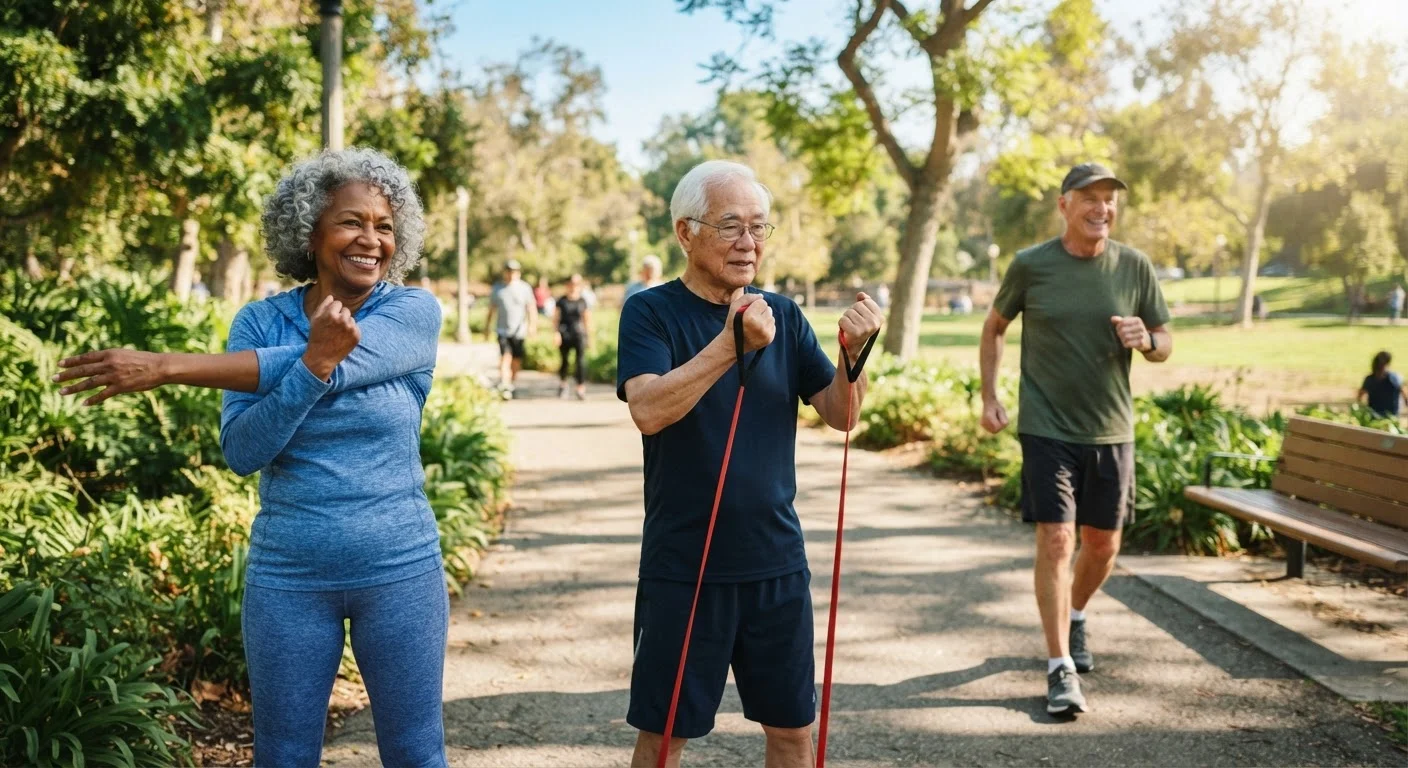
- Muscular strength: Resistance training — using weights, bands, or bodyweight — preserves muscle mass and protects joints. See our beginner's guide to strength training for older adults for a structured starting point.
- Flexibility and mobility: Stretching and mobility work maintain range of motion and reduce injury risk. These two qualities are related but distinct — our article on flexibility and mobility in healthy aging explains the difference clearly.
- Balance and coordination: Tai chi, single-leg stands, and similar exercises directly target fall prevention, which is one of the most consequential health risks for adults over 65.
Most exercise guidelines recommend incorporating all four pillars weekly, with the specific balance adjusted to individual ability and health status.
38%
Reduction in fall-related injury risk
A Cochrane review of exercise interventions found that balance and functional exercise programs reduced fall-related injuries among older adults by approximately 38%.
2–3×
Weekly strength sessions recommended
Major public health guidelines, including those from the CDC and WHO, recommend muscle-strengthening activities on at least two to three days per week for older adults.
~3–8%
Muscle mass lost per decade after 30
Research estimates adults lose between 3% and 8% of muscle mass per decade after age 30, with the rate accelerating significantly after 60 without resistance training.
Decade-by-Decade: What Exercise Looks Like in Your 60s, 70s, and 80s
There is no single template for aging well through movement. Physical capacity, health history, and prior fitness experience vary enormously between individuals. That said, general patterns by decade can help set realistic expectations.
In Your 60s
Many adults in their 60s are capable of moderately vigorous activity. This is an ideal time to build or protect a fitness base — establishing strength and aerobic habits before the steeper physical changes of later decades. Resistance training two to three times per week, combined with 150 minutes of moderate aerobic activity weekly (per general public health guidance), is a widely supported framework. Joint awareness becomes more important; high-impact options like running may need modification.
In Your 70s
Balance training becomes increasingly important, and recovery time between sessions typically extends. Low-impact activities like swimming and water aerobics deliver real cardiovascular and strength benefits without the joint stress of higher-impact options. Strength work remains essential — even modest resistance training produces measurable muscle and functional benefits in this decade.
In Your 80s and Beyond
The priority often shifts toward functional fitness: the strength to rise from a chair, the balance to navigate stairs, the flexibility to dress independently. Chair-based exercise, gentle yoga, and short walks all count meaningfully. The key principle is that some movement is almost always better than none, and even late starters gain measurable benefits from starting activity programs.
Common Barriers and How to Work Around Them
Older adults face real obstacles to staying active — and acknowledging them honestly is more useful than minimizing them.
- Chronic pain or joint conditions
- Many forms of movement can be adapted or modified. A physical therapist can design programs that work around specific limitations rather than ignoring them.
- Fear of injury or falling
- Paradoxically, targeted exercise — especially balance and strength training — is one of the most evidence-based tools for reducing fall risk. Starting slowly with qualified guidance builds confidence alongside ability.
- Lack of motivation or social support
- Group fitness classes, walking clubs, and community center programs address both isolation and accountability simultaneously. The social dimension of exercise is a genuine benefit, not just a bonus.
- Fatigue or low energy
- For many older adults, moderate-intensity movement actually increases energy levels over time, even when it feels counterintuitive in the moment. Short sessions — even ten to fifteen minutes — are a valid starting point.
Connecting exercise choices to the broader longevity habits you already practice — sleep, nutrition, stress management — can reinforce motivation by framing fitness as part of an integrated approach to healthy aging.
Recovery, Rest, and Listening to Your Body
Recovery is not optional at any age, and its importance grows with each decade. Muscle repair, inflammation resolution, and nervous system recovery all take longer as the body ages — this is physiology, not weakness.
Practically, this means that older adults typically benefit from more rest days between strength sessions, greater attention to sleep quality, and willingness to reduce intensity during periods of illness or high stress. Our resource on how recovery needs shift across the lifespan offers a detailed framework for understanding these changes.
Pain that persists beyond 24 hours after exercise, or any new chest discomfort, dizziness, or shortness of breath during activity, warrants prompt medical evaluation — not self-management.
Getting Started: Practical Next Steps
The most effective exercise program is one you'll actually do. Start by identifying activities you genuinely enjoy or are curious about — adherence over months and years matters far more than short-term intensity.
Before beginning a new exercise routine, especially if you have existing health conditions or have been sedentary, speak with your primary care provider or a physical therapist. They can identify appropriate starting points, flag contraindications, and help you set realistic progress markers.
From there, small commitments compound. A ten-minute daily walk becomes a twenty-minute walk. Bodyweight movements at home build a foundation for eventual resistance training. Progress in later-life fitness often looks different from younger decades — and that's entirely appropriate.
The body's capacity to adapt doesn't disappear with age. It simply asks for consistency, respect, and a little patience.
This article is for general informational and educational purposes only and is not a substitute for personalized medical advice. Always consult a qualified healthcare professional before beginning or significantly modifying an exercise program, particularly if you have existing health conditions, mobility limitations, or are recovering from illness or injury.