

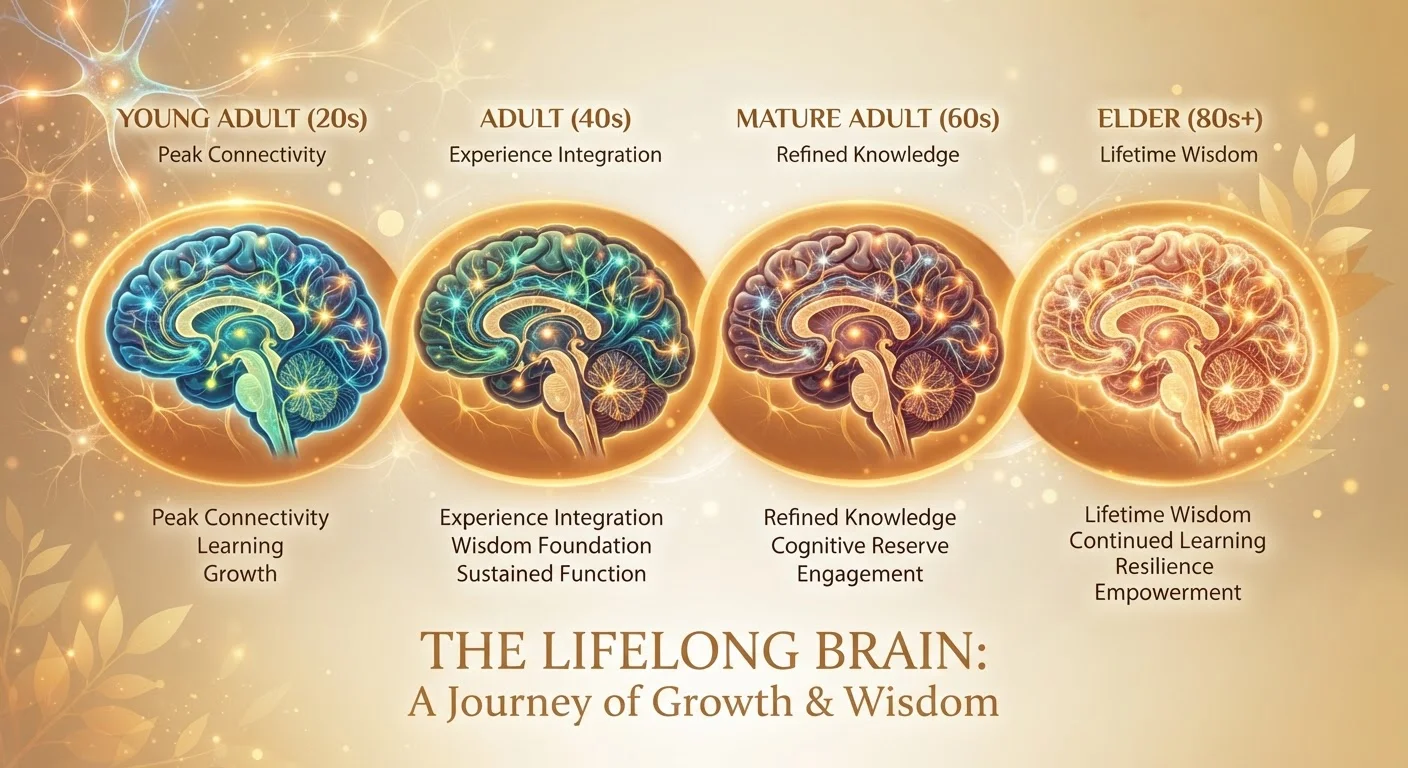
Key Takeaways
- Brain aging begins subtly in the 30s but varies greatly between individuals.
- Processing speed and working memory are often the first cognitive functions to show change.
- Lifestyle habits — sleep, exercise, social connection — have measurable effects on cognitive trajectory.
- Cognitive reserve, built over a lifetime, helps the brain compensate for age-related changes.
- Normal forgetfulness differs from clinically significant memory loss; a doctor can help distinguish them.
- It is never too early or too late to adopt habits that support long-term brain health.
Why Brain Aging Is Not One Straight Decline
Most people imagine cognitive aging as a slow, uniform fade — a steady dimming that begins somewhere in middle age and only moves in one direction. The science tells a more nuanced story. Different cognitive abilities peak, plateau, and change at different times, and individual variation is enormous. Some capacities, like vocabulary and accumulated knowledge, often remain strong well into later decades. Others, like the speed at which the brain processes new information, may begin shifting earlier than most people expect.
Understanding these patterns matters because it shifts the conversation from inevitability to agency. The brain is not simply a passive victim of time. Neuroplasticity — the brain's capacity to adapt and reorganize — persists across the lifespan, even if it changes in character. What you do in your 30s, 40s, 50s, and beyond meaningfully shapes your cognitive trajectory. See our guide to cognitive reserve for a deeper look at how the brain builds resilience over time.
Your 30s: The Quiet Shift Begins
Research suggests that some aspects of processing speed and working memory — the mental workspace used to hold and manipulate information in real time — begin showing subtle changes as early as the late 20s and into the 30s. These changes are typically imperceptible in daily life, but they represent the beginning of a long, gradual arc rather than a cliff that appears later.
This decade is also when lifestyle choices start compounding. Chronic sleep debt, chronic stress, and sedentary habits begun now can accelerate later changes, while protective habits established now build a foundation that pays forward. The longevity habits that support brain health are most powerful when started early. If you're in your 30s and thinking about preventive health broadly, our article on health screenings in your 30s covers what to track during this decade.
Treat your 30s as the brain health equivalent of saving for retirement: the earlier you start, the more compounding works in your favor. Prioritizing sleep, consistent exercise, and stress management now sets a baseline that is far easier to maintain than to rebuild.
Longitudinal research consistently shows that midlife lifestyle factors — including physical activity and sleep — predict cognitive outcomes decades later, underscoring the value of early investment.
When learning a new skill, choose something genuinely challenging rather than simply enjoyable repetition. True novelty and difficulty are what drive the neural adaptation associated with building cognitive reserve.
Studies on skill acquisition and neuroplasticity suggest that effortful learning — not passive engagement — is the driver of meaningful structural and functional changes in the brain.
Your 40s and 50s: Processing Speed and Memory Under Pressure
By midlife, many people notice something real: names take a beat longer to retrieve, multitasking feels more effortful, and concentration can feel less automatic under stress. These experiences are common, and for most people they reflect normal age-related change rather than disease. The brain's white matter — the wiring that connects regions — changes in composition during this period, which can affect the speed and efficiency of information transfer.
Crucially, this is also when modifiable risk factors have some of their greatest leverage. Hypertension, poor sleep, physical inactivity, and social isolation in midlife are each associated with elevated risk of cognitive decline later. Aerobic exercise, in particular, has consistent research support for supporting brain volume and blood flow. Our complete guide to active aging covers how physical activity patterns can be adapted across each decade. Diet also plays a role — see our article on foods linked to cognitive health for what the evidence actually supports.
~40%
Of dementia risk linked to modifiable factors
A 2020 Lancet Commission analysis estimated that approximately 40% of dementia cases worldwide could theoretically be prevented or delayed by addressing twelve modifiable risk factors across the lifespan.
7–9 hrs
Recommended nightly sleep for most adults
The American Academy of Sleep Medicine and Sleep Research Society recommend seven to nine hours of sleep per night for adults, citing cognitive function and long-term brain health among the key rationales.
Late 20s
When some processing speed changes begin
Research published in cognitive aging journals, including work drawing on large lifespan datasets, places the earliest measurable shifts in processing speed in the late 20s, well before most people notice any change.
Your 60s and Beyond: Protecting What You've Built
Entering the 60s, the pace of change can become more noticeable — though the range of experience remains wide. Some people in their late 60s and 70s perform comparably to younger adults on many cognitive tasks. What distinguishes them often comes down to the accumulated effect of decades of health habits, educational engagement, social connection, and management of cardiovascular risk factors — the building blocks of cognitive reserve.
Sleep becomes an especially important lever in this decade. Sleep architecture shifts with age, and disrupted or shortened sleep has well-documented effects on memory consolidation and the clearance of metabolic waste from the brain. Understanding what's normal versus what warrants attention is covered in our companion piece on how age changes sleep. Social engagement also matters: sustained meaningful connection is one of the more consistently cited protective factors in aging research. If you're just beginning to think systematically about brain health, starting a brain health routine after 60 offers a practical starting point.
Habits That Support Brain Health at Every Stage
Across all decades, a cluster of evidence-backed habits appears repeatedly in cognitive health research. No single habit is a guarantee, but together they meaningfully support a healthier trajectory:
- Regular aerobic movement — even brisk walking — supports cerebral blood flow and has been associated with larger hippocampal volume in observational studies.
- Consistent, quality sleep — seven to nine hours for most adults — supports memory consolidation and the brain's glymphatic waste-clearance system.
- Cognitively stimulating activities — learning new skills, reading, puzzles — contribute to cognitive reserve, not by preventing change but by giving the brain more capacity to compensate.
- Social connection — sustained relationships and community involvement are linked to slower cognitive decline in longitudinal research.
- Cardiovascular risk management — keeping blood pressure, blood sugar, and cholesterol in healthy ranges protects the vascular health that underlies brain function.
Use our annual brain health self-check to take stock of where you stand across these dimensions and identify gaps worth discussing with a doctor.
When to Talk to a Doctor
Normal cognitive aging is gradual, consistent across similar tasks, and does not interfere significantly with daily function. Forgetting where you put your keys is different from forgetting what keys are for. If you or someone close to you notices changes that are affecting work, finances, relationships, or safety — or if changes seem rapid rather than gradual — that warrants a conversation with a qualified healthcare provider.
Early evaluation is valuable not because it guarantees a particular outcome, but because some causes of cognitive change are treatable (including thyroid disorders, sleep apnea, vitamin deficiencies, and medication side effects), and because early engagement with a care team opens more options. Do not delay out of fear; instead, treat it as the same kind of proactive step you would take for any other aspect of health.
This article is for general informational and educational purposes only and is not a substitute for professional medical advice, diagnosis, or treatment. Always consult a qualified healthcare provider with questions about your own health or any changes in cognition you have noticed.