

| Number of Americans living with Alzheimer's disease | Approximately 6.7 million (age 65+) (Alzheimer's Association, 2023) |
| Age at which processing speed begins to noticeably slow | Around age 30, on average (Research consensus, multiple longitudinal studies) |
| Most common form of dementia | Alzheimer's disease (~60–80% of cases) (Alzheimer's Association) |
| Modifiable risk factors linked to dementia | Up to 12 identified factors (Lancet Commission on Dementia Prevention, 2020) |
| Percentage of MCI cases that progress to dementia within 5 years | Roughly 10–15% per year (National Institute on Aging estimates) |
Why This Vocabulary Matters
Conversations about brain aging can move quickly into unfamiliar territory. You might hear your doctor mention mild cognitive impairment at an annual checkup, read about neuroplasticity in a health magazine, or encounter the word biomarker in a news story about Alzheimer's research. Without a working definition of these terms, it is hard to assess what you are hearing or ask useful follow-up questions.
This reference is designed to close that gap. The definitions below reflect current scientific and clinical usage. Where research is still evolving — as it is in several areas of dementia science — that uncertainty is noted. For a complementary look at the vocabulary used in emotional and mental wellness, see our plain-language emotional wellness glossary.
This Content Is General Information, Not Medical Advice
The definitions here are intended to help you understand terminology used in conversations, research summaries, and clinical settings. They do not replace guidance from a qualified healthcare provider. If you have concerns about your memory or cognitive health, please consult your doctor or a neurologist.
Core Terms Defined
The terms below appear most frequently in clinical conversations, research summaries, and public health guidance related to cognitive aging. Use them as a lookup reference — you do not need to read in order.
Neuroplasticity
The brain's ability to reorganize itself by forming new neural connections throughout life. It underlies learning, memory, and recovery from injury, and is supported by mentally stimulating activities, physical exercise, and adequate sleep.
Cognitive Reserve
The brain's resilience against age-related changes or damage, built up over a lifetime through education, complex work, social engagement, and mentally demanding leisure. A larger cognitive reserve is associated with a delayed onset of noticeable decline.
Mild Cognitive Impairment (MCI)
A condition in which a person experiences cognitive changes — such as memory lapses — that are beyond what is expected for their age but do not significantly interfere with daily life. MCI may or may not progress to dementia; diagnosis requires evaluation by a qualified clinician.
Executive Function
A set of mental skills — including planning, flexible thinking, working memory, and impulse control — that help people manage tasks and make decisions. Executive function is coordinated largely by the prefrontal cortex and tends to be sensitive to aging, stress, and sleep loss.
Processing Speed
How quickly the brain can take in, interpret, and respond to information. Processing speed is one of the earliest cognitive abilities to slow with age, though this does not necessarily affect accuracy or judgment.
Hippocampus
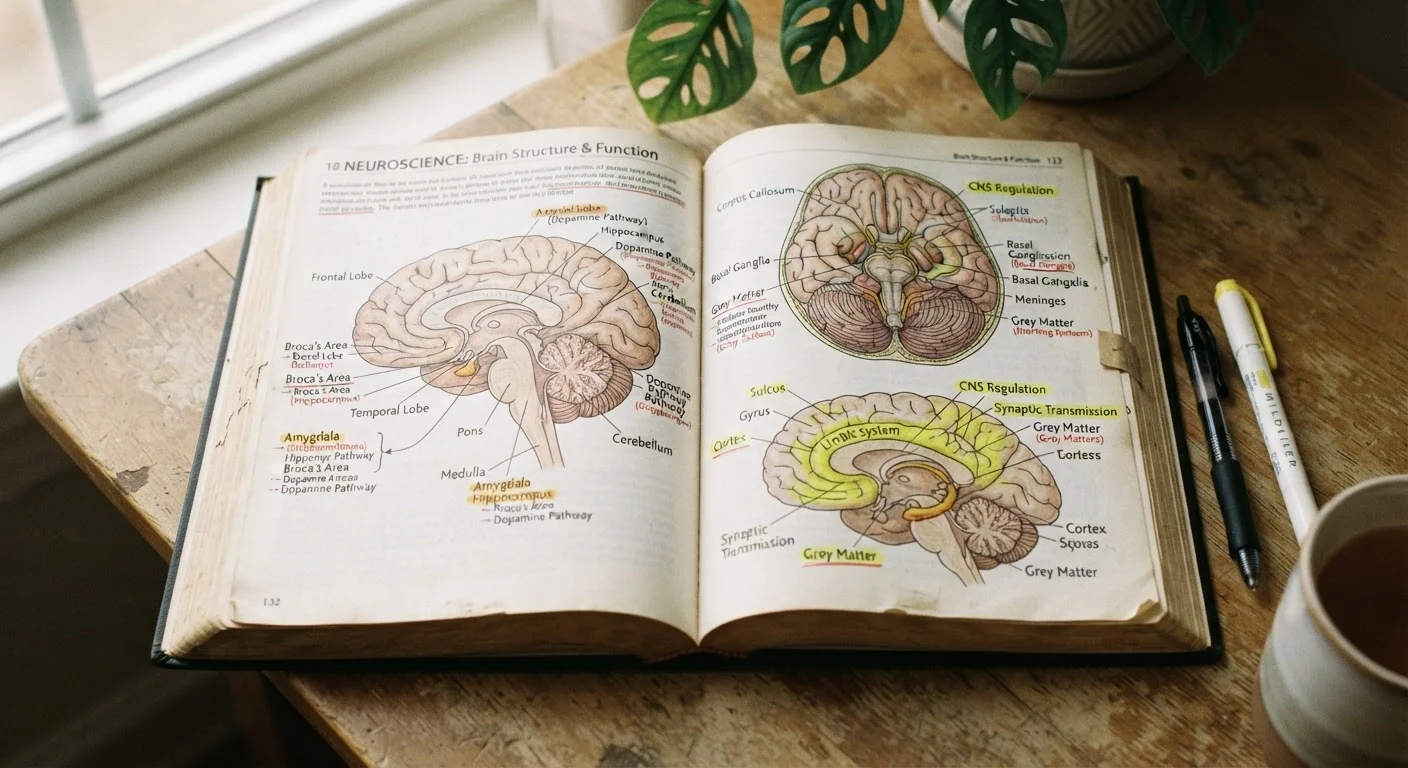
A seahorse-shaped brain structure in the medial temporal lobe that plays a central role in forming and retrieving memories. The hippocampus is particularly vulnerable to stress hormones and is one of the first regions affected in Alzheimer's disease.
Amyloid Plaques
Clumps of a protein fragment called beta-amyloid that can accumulate between nerve cells in the brain. Amyloid plaque buildup is a hallmark of Alzheimer's disease, though its precise role in cognitive decline remains an active area of scientific research.
Dementia
An umbrella term for a group of symptoms — including memory loss, language difficulties, and impaired reasoning — severe enough to interfere with daily life. Dementia is not a single disease; Alzheimer's disease is its most common cause, followed by vascular dementia.
Working Memory
The temporary storage system that holds and manipulates a small amount of information in conscious awareness for immediate use, such as remembering a phone number while you dial it. Working memory capacity is closely tied to overall cognitive performance.
Neurodegeneration
The progressive loss of structure or function of neurons, including the death of nerve cells. It underlies conditions such as Alzheimer's, Parkinson's, and ALS, and is distinct from normal age-related changes in brain structure.
Cognitive Decline
A gradual reduction in one or more cognitive abilities over time. Some degree of cognitive slowing is a normal part of aging, while more pronounced decline may indicate an underlying condition requiring medical evaluation.
Biomarker
A measurable biological indicator — such as a protein level in cerebrospinal fluid or a pattern visible on a brain scan — used by clinicians and researchers to detect, monitor, or characterize disease. Biomarkers for Alzheimer's disease are an active area of clinical development.
For a deeper look at one of the most practically useful concepts above, see what cognitive reserve actually means for your aging brain. And if you want to understand how these changes unfold decade by decade, brain health across the decades offers a structured timeline with evidence-based strategies for each life stage.
At a Glance: Key Numbers in Cognitive Health
Research on brain aging involves a lot of statistics that can be difficult to put in context. The figures below are drawn from widely cited public health sources and are intended to give you a sense of scale — not to predict individual outcomes.
| Number of Americans living with Alzheimer's disease | Approximately 6.7 million (age 65+) (Alzheimer's Association, 2023) |
| Age at which processing speed begins to noticeably slow | Around age 30, on average (Research consensus, multiple longitudinal studies) |
| Most common form of dementia | Alzheimer's disease (~60–80% of cases) (Alzheimer's Association) |
| Modifiable risk factors linked to dementia | Up to 12 identified factors (Lancet Commission on Dementia Prevention, 2020) |
| Percentage of MCI cases that progress to dementia within 5 years | Roughly 10–15% per year (National Institute on Aging estimates) |
These numbers reflect population-level patterns. Individual risk is shaped by genetics, lifestyle, chronic conditions, and many other factors. Habits that support cardiovascular health, quality sleep, and social connection are among those most consistently linked to lower dementia risk in the research literature. Physical activity is another well-studied lever — the active aging hub covers how movement supports both body and brain over time.
This article is for informational purposes only and does not constitute medical advice. Speak with a qualified healthcare professional for guidance specific to your health history and concerns.