

Key Takeaways
- A sleep study (polysomnography) records brain waves, breathing, oxygen levels, and movement simultaneously overnight.
- Most studies take place in a dedicated lab, though home sleep apnea tests are available for specific situations.
- Sensors are attached with gentle adhesive and conductive gel — they are not painful or invasive.
- Results are interpreted by a sleep specialist and typically take one to three weeks to reach your doctor.
- A referral from your primary care provider is usually the first step toward scheduling a study.
What you will need
Why Doctors Order Sleep Studies
A sleep study is a diagnostic tool, not a treatment. Physicians order one when a patient's reported symptoms — chronic snoring, witnessed pauses in breathing, excessive daytime sleepiness, or unusual nighttime behaviors — suggest a condition that can only be confirmed with objective overnight data. Common reasons include suspected obstructive sleep apnea (OSA), restless legs syndrome, narcolepsy, or parasomnias such as sleepwalking.
Understanding what might be disrupting your rest is the foundation. For a broader look at the conditions a sleep study can help identify, see Sleep Disorders Explained. For a deeper dive into how these disorders affect the brain, What Actually Happens in Your Brain During a Sleep Disorder offers useful context.
The formal name for the standard in-lab overnight test is polysomnography (PSG). It simultaneously records multiple physiological signals, giving clinicians a detailed picture of what happens across your entire sleep cycle rather than a single snapshot.
What you will need
What to Expect: Before, During, and After
Navigating a sleep study is straightforward once you know what each phase involves. The steps below cover the full arc from pre-study preparation through receiving your results.
Get a referral and confirm the type of study
Your primary care provider or a specialist (such as a pulmonologist or neurologist) will determine whether you need an in-lab polysomnography or a Home Sleep Apnea Test (HSAT). HSATs monitor fewer signals and are typically used only when OSA is the primary concern. In-lab PSG is more comprehensive and is used for a wider range of suspected disorders. Clarify with your doctor which study is appropriate before booking.
Prepare for the night before and day of the study
Follow any instructions your sleep lab provides. In general: avoid caffeine after noon on the day of the study, skip naps, and wash your hair without leaving conditioner in (conditioner can interfere with electrode adhesion). Bring comfortable pajamas, your usual toiletries, and any medications you take at night. Arrive at the scheduled check-in time, typically between 8:00 and 10:00 p.m.
Get set up with sensors and electrodes
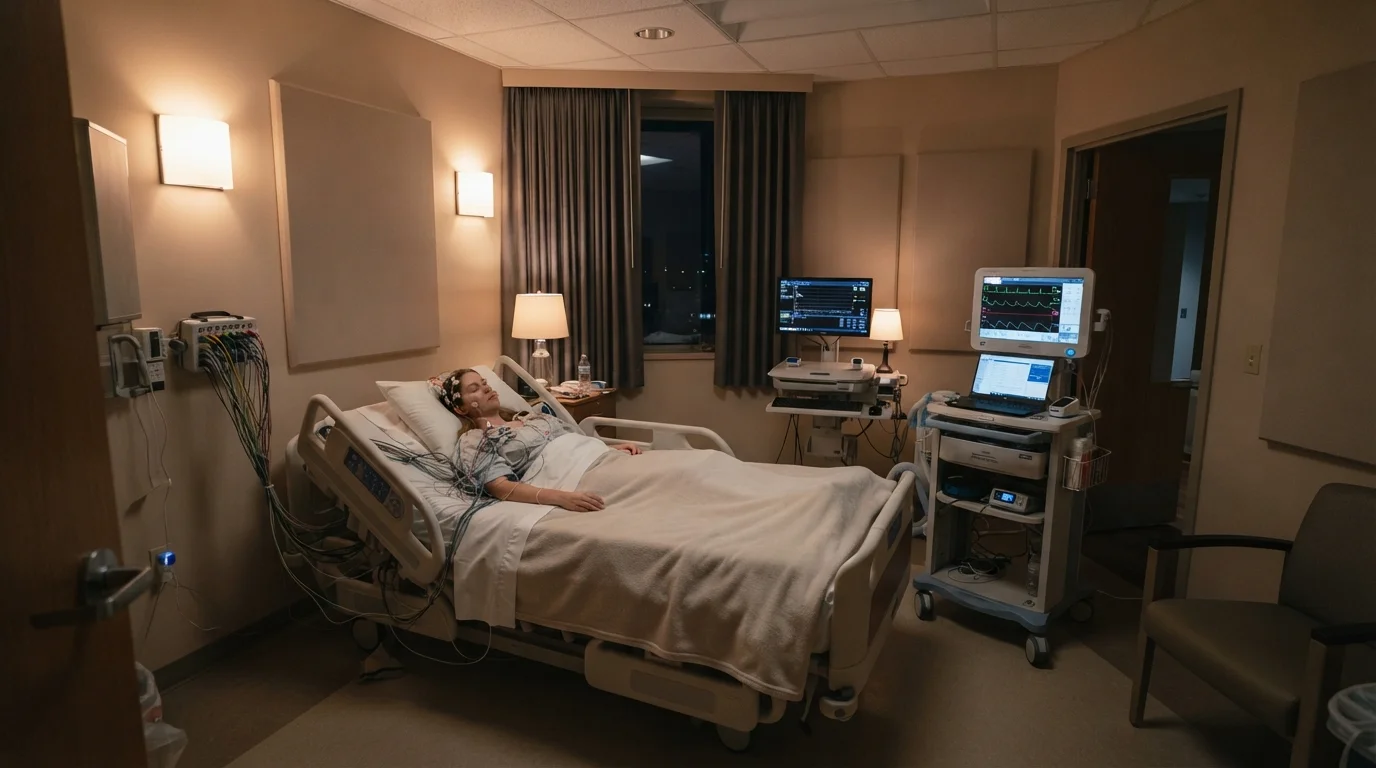
A sleep technologist will apply sensors using conductive gel and medical-grade adhesive. Typical placements include the scalp (to record brain activity via EEG), around the eyes (to detect eye movements), on the chin (to measure muscle tone), on the chest and legs, and on a finger (pulse oximeter for oxygen levels). Elastic belts are placed around the chest and abdomen to track breathing effort. Setup takes roughly 30–60 minutes and should not be painful.
Sleep while data is recorded
Once you're in bed and the lights go out, the technologist monitors all signals from an adjacent room throughout the night. You can move, use the restroom, or call for assistance at any time — sensors are bundled into a single cable that can be temporarily disconnected. Most studies aim to capture at least six hours of sleep data, though you don't need to sleep perfectly for the study to be useful.
Wake up, have sensors removed, and go home
Wake-up time is generally between 5:30 and 7:00 a.m. The technologist will remove all sensors — gel residue washes out easily with shampoo or soap. You'll be free to leave and continue your normal day. The raw data collected overnight is then scored by the technologist and reviewed by a board-certified sleep physician before a report is generated.
Home Tests Are Not a Universal Substitute
Home sleep apnea tests are validated for screening straightforward cases of suspected OSA in otherwise healthy adults. They are not appropriate for diagnosing other sleep disorders, and they may underestimate apnea severity in some individuals. If your doctor recommends an in-lab study, that guidance reflects clinical judgment about what your situation requires.
Reading Your Results and Next Steps
Once your study is scored, the sleep specialist generates a detailed report. Key metrics include the Apnea-Hypopnea Index (AHI) — the average number of breathing interruptions per hour — along with sleep efficiency, time spent in each sleep stage, and oxygen saturation trends. Your referring physician reviews this report and discusses findings with you, usually within one to three weeks.
A diagnosis from a sleep study opens the door to targeted treatment. Depending on findings, options might include CPAP therapy, positional therapy, behavioral interventions, or referral to another specialist. Separately, improving everyday sleep habits can support whatever clinical plan your provider recommends — Sleep Hygiene Explained is a practical starting point. If you want the science behind those habits, The Full Picture on Sleep Hygiene goes deeper.
This article is for general informational purposes only and is not a substitute for professional medical advice, diagnosis, or treatment. Always consult a qualified healthcare provider with questions about your health or before making any medical decisions.