

Key Takeaways
- Probiotics introduce live beneficial bacteria into the gut; prebiotics feed the bacteria already there.
- Roughly 70% of the immune system is associated with gut-associated lymphoid tissue, making microbiome health central to immunity.
- Both probiotics and prebiotics can influence immune regulation, but through different biological mechanisms.
- Dietary sources — fermented foods and fiber-rich plants — provide both without requiring supplements.
- Neither probiotics nor prebiotics are a universal immune cure; individual responses vary considerably.
- Combining both (a synbiotic approach) may offer compounded benefits, though research is still developing.
Option A
Probiotics
Live microorganisms that add beneficial bacteria to your gut.
Best for: People looking to replenish or diversify their gut bacterial populations, particularly after disruption from antibiotics or illness.
Option B
Prebiotics
Non-digestible fibers that nourish and sustain your existing gut bacteria.
Best for: Anyone wanting to strengthen and feed the beneficial bacteria already living in their gut through dietary fiber intake.
If you want to replenish gut bacteria after a course of antibiotics
Probiotics
Antibiotics can deplete beneficial gut bacteria; probiotics introduce live microorganisms that may help restore microbial balance more directly during the recovery window.
If you want to sustain long-term gut microbiome diversity
Prebiotics
Consistently feeding your existing beneficial bacteria with prebiotic fibers supports stable, diverse microbial populations over time, which is fundamental to ongoing immune regulation.
If you prefer to get benefits through whole foods rather than supplements
Prebiotics
Prebiotic fibers are abundant in everyday foods like onions, garlic, oats, and bananas, making dietary intake achievable without supplementation for most people.
If you are interested in supporting immune balance alongside digestive comfort
Probiotics
Certain well-studied probiotic strains have been shown in research to modulate immune signaling pathways and may help reduce the duration of common digestive-linked immune disruptions.
If you want a combined approach to gut-immune support
Probiotics
Pairing probiotics with prebiotic-rich foods (a synbiotic strategy) may allow introduced bacteria to survive and thrive longer, though consulting a healthcare provider is advisable before starting any supplement regimen.
Two Different Roles in the Same System
The terms probiotics and prebiotics are frequently used interchangeably, but they describe fundamentally different things. Understanding the distinction matters — especially when the goal is supporting immune health through the gut. For a deeper look at how these two concepts relate more broadly, see our guide on prebiotics and probiotics.
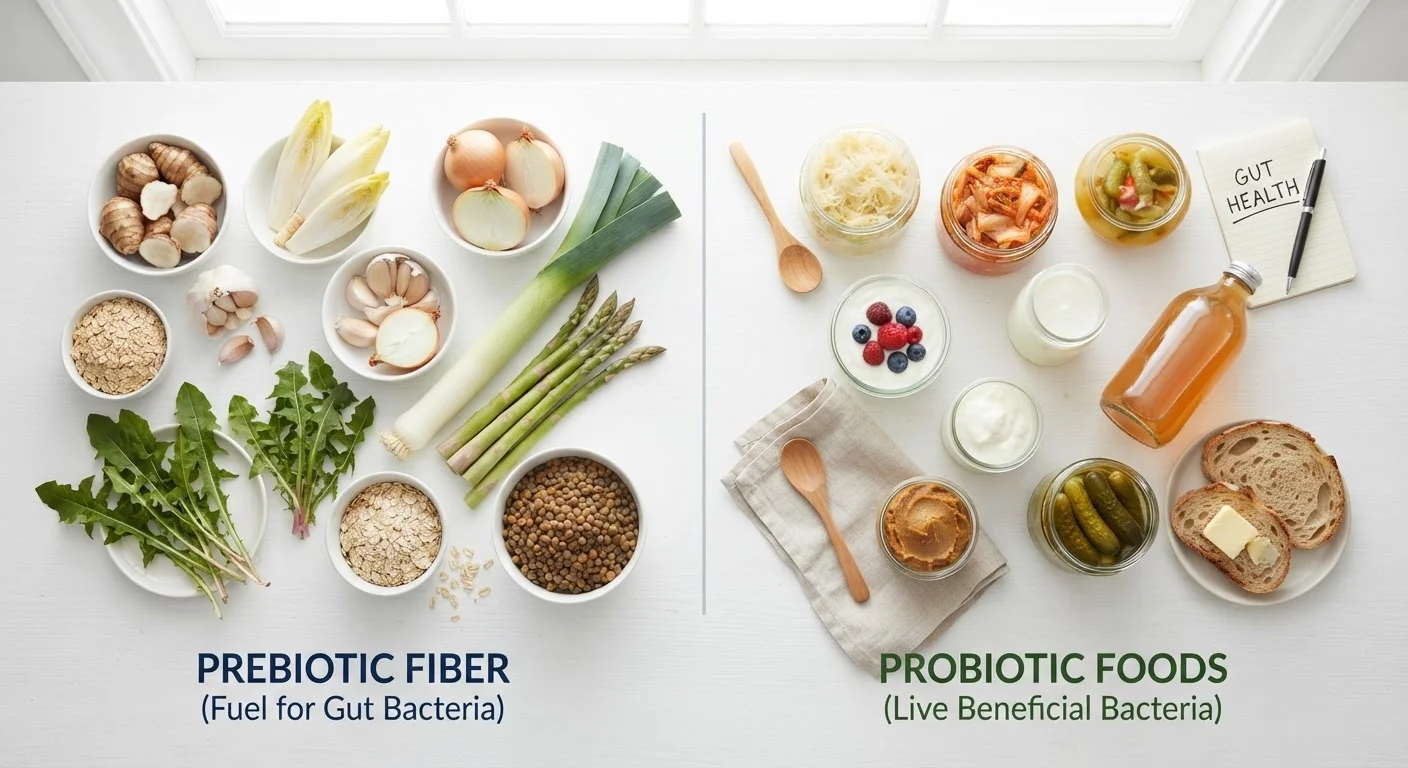
Probiotics are live microorganisms — primarily bacteria and some yeasts — that, when consumed in adequate amounts, confer a health benefit on the host. They are found in fermented foods such as yogurt, kefir, kimchi, and sauerkraut, and are also available as dietary supplements. When you consume probiotics, you are literally adding microorganisms to your gut ecosystem.
Prebiotics, by contrast, are a category of non-digestible dietary fibers and compounds that selectively stimulate the growth or activity of beneficial bacteria already present in your gut. Think of them as fertilizer for your existing microbial garden. Common sources include garlic, onions, leeks, asparagus, oats, and bananas.
A Note on Synbiotics
The term 'synbiotic' refers to products or dietary approaches that combine both probiotics and prebiotics together. The idea is that the prebiotic component provides an immediate food source for the introduced probiotic bacteria, potentially improving their survival and activity in the gut. While this approach is promising, the clinical evidence for synbiotics specifically is still developing and results vary by strain and fiber combination. Speak with a healthcare professional before adding synbiotic supplements to your routine.
The gut microbiome — the vast community of trillions of microorganisms living in your digestive tract — is not a passive bystander in immune function. To understand the broader gut-immune relationship, our beginner's roadmap to the gut microbiome and immune function covers the key mechanisms clearly.
How Each One Influences Immune Function
Approximately 70% of the body's immune cells are housed in gut-associated lymphoid tissue (GALT), which sits along the intestinal lining. This anatomical proximity means the microbial balance of the gut has a direct line of communication to immune signaling — and both probiotics and prebiotics engage that system, just differently.
Probiotics and immunity: Certain probiotic strains — particularly species within Lactobacillus and Bifidobacterium genera — have been shown in clinical research to modulate immune responses. They can interact with intestinal epithelial cells and immune cells, influencing the production of cytokines (chemical messengers that regulate inflammation) and supporting the integrity of the gut's mucosal barrier. A more intact barrier limits the passage of potentially harmful substances into the bloodstream, reducing the burden on the immune system. Research on fermented foods explores how food-based probiotic sources fit into this picture.
Prebiotics and immunity: When beneficial bacteria ferment prebiotic fibers in the colon, they produce short-chain fatty acids (SCFAs) such as butyrate, propionate, and acetate. SCFAs are not metabolic byproducts to be ignored — they actively regulate immune cell behavior, help maintain the gut lining, and support anti-inflammatory signaling throughout the body. By feeding the bacteria that produce SCFAs, prebiotics indirectly but meaningfully influence immune tone.
| Criterion | Probiotics | Prebiotics |
|---|---|---|
| What they are | Live beneficial microorganisms | Non-digestible fibers and compounds |
| Primary action | Add bacteria to the gut | Feed existing gut bacteria |
| Key immune mechanism | Modulate cytokines, strengthen gut barrier | Stimulate SCFA production, reduce inflammation |
| Common food sources | Yogurt, kefir, kimchi, sauerkraut | Garlic, onions, oats, bananas, asparagus |
| Supplement availability | Widely available; strain matters | Available; also easily obtained from diet |
| Evidence strength | Strain-specific; varies considerably | Consistent for fiber-based immune support |
| Heat/stability sensitivity | Live organisms can be killed by heat | Generally stable; survives cooking |
What the Evidence Actually Supports
It is worth being clear about what current science can and cannot claim. Research supports the general principle that a diverse, well-nourished gut microbiome is associated with more resilient immune function. Both probiotics and prebiotics contribute to that environment — but the evidence is nuanced.
Probiotic research is highly strain-specific. What is demonstrated for one strain of Lactobacillus acidophilus does not automatically apply to another species or blend. Similarly, prebiotic effects depend on the type of fiber and the individual's existing microbiome composition. A closer comparison of which does more for immune health examines the evidence side by side in more detail.
Common misconceptions about the gut-immune connection — including the idea that any probiotic supplement universally boosts immunity — are worth examining critically. Persistent gut-immune myths addresses several of these directly.
Dietary fiber type also matters for prebiotic impact. Understanding soluble versus insoluble fiber helps clarify which fiber types are most relevant for microbiome support.
This article is for general informational and educational purposes only and is not a substitute for professional medical advice, diagnosis, or treatment. Always consult a qualified healthcare provider before starting any new supplement regimen or making significant dietary changes, especially if you have an existing health condition.