
Chronic Stress and Cellular Aging: How Prolonged Tension Affects Your Body Over Time

Key Takeaways
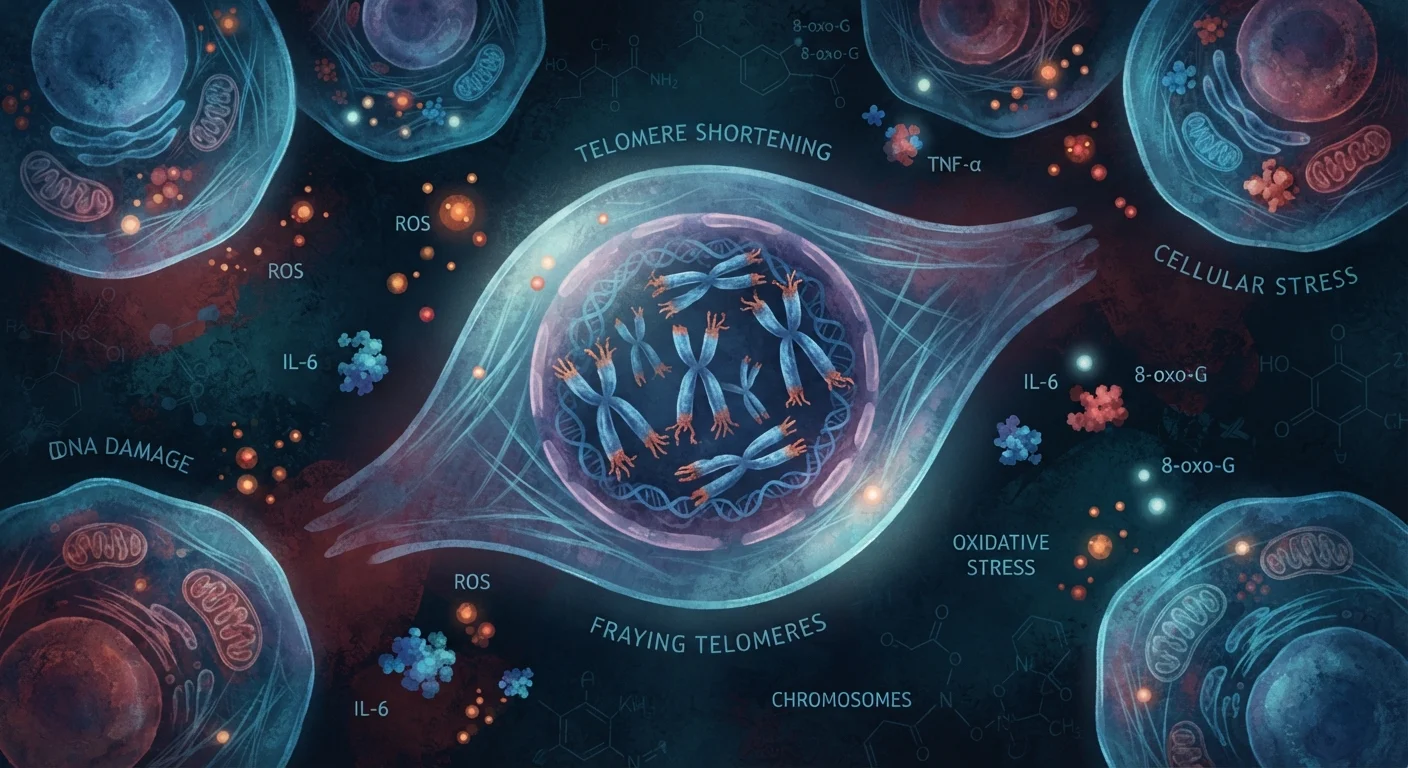
- Chronic stress accelerates cellular aging by shortening telomeres, the protective caps on your DNA.
- Sustained stress promotes systemic inflammation, a recognized driver of many age-related diseases.
- The stress hormone cortisol, when chronically elevated, disrupts immune function and metabolic health.
- Mind-body practices and strong social connections show measurable protective effects on biological aging.
- Cellular aging from stress is not inevitable — lifestyle habits can meaningfully slow the process.
Chronic Stress and Cellular Aging
Chronic stress is prolonged psychological or physical tension that keeps the body's stress-response system activated beyond what it was designed to handle. Over time, this sustained activation accelerates biological aging at the cellular level — influencing how quickly cells deteriorate, how the immune system functions, and how susceptible the body becomes to age-related disease. Unlike short-term stress, which is normal and often beneficial, chronic stress reshapes the body's internal environment in ways that compound over months and years.
Much of the research in this area focuses on telomeres — protective caps on chromosomes — and markers of systemic inflammation such as C-reactive protein and pro-inflammatory cytokines, both of which are measurably affected by sustained psychological stress.
What Happens Inside Your Cells During Prolonged Stress
When you perceive a threat — whether a work deadline or a financial worry — your brain triggers the release of stress hormones, primarily cortisol and adrenaline. This response is adaptive in the short term: it sharpens focus, mobilizes energy, and prepares the body to respond. The problem arises when the trigger never fully resolves.
Under chronic stress, cortisol remains elevated for extended periods. One consequence measured in research is accelerated telomere shortening. Telomeres are repetitive DNA sequences that cap the ends of chromosomes, protecting genetic material during cell division. A 2004 landmark study published in the journal Proceedings of the National Academy of Sciences found that mothers caring for chronically ill children — a population experiencing sustained psychological stress — had significantly shorter telomeres than low-stress comparison groups, with an estimated difference equivalent to roughly a decade of additional cellular aging.
Subsequent research has replicated the association across diverse populations, linking job strain, caregiving burden, trauma exposure, and financial hardship to shorter telomere length. This does not mean stress alone determines biological age, but it does mean that stress is one measurable contributor to how quickly cellular wear accumulates.
“The pace of biological aging is not set in stone. Psychological states — including chronic stress — interact with molecular processes in ways we are only beginning to map, and the findings carry real implications for how we think about lifestyle and longevity.”
— Elissa Epel, Stress researcher and professor at the University of California, San Francisco; co-author of research on telomeres and psychological stress
The Inflammation Pathway: A Key Mechanism
Telomere length is one window into cellular aging; systemic inflammation is another. Chronic stress activates the body's immune signaling network even in the absence of infection or injury. Stress hormones promote the release of pro-inflammatory cytokines — chemical messengers that, at elevated levels over time, contribute to tissue damage throughout the body.
This low-grade, persistent inflammation is associated with a cluster of conditions that become more common with age: cardiovascular disease, type 2 diabetes, certain cancers, and cognitive decline. For a deeper look at how cortisol specifically suppresses immune defenses, see how chronic stress affects the immune system.
The brain is not exempt from these effects. Sustained inflammation and cortisol exposure affect the hippocampus — a brain region central to memory and learning — and may alter the structural integrity of neural networks over time. What chronic stress does to the brain over time outlines the research in detail.
~10 years
Estimated cellular aging gap in high-stress caregivers
A foundational 2004 PNAS study found high-stress caregivers showed telomere length equivalent to roughly a decade more cellular aging than low-stress comparison participants.
2–3×
Elevated inflammatory marker risk under chronic stress
Research published in psychoneuroimmunology journals has found chronically stressed individuals can show two to three times higher levels of pro-inflammatory cytokines compared to low-stress peers.
~30%
Reduced telomere shortening rate with regular exercise
A study in Preventive Medicine found that adults engaging in regular physical activity showed telomere lengths associated with up to roughly 30% less shortening compared to sedentary adults of similar age.
Social and Behavioral Factors That Shape the Outcome
Biological aging from stress is not a fixed destiny. The same body of research that identified stress-related cellular damage also points to factors that appear to moderate it. Among the most consistently supported:
- Physical activity: Regular moderate exercise is associated with longer telomere length and lower inflammatory markers in multiple observational studies.
- Sleep quality: Restorative sleep is when many cellular repair processes occur. Chronic poor sleep amplifies stress-related inflammation.
- Social connection: Meaningful relationships buffer the physiological stress response. Loneliness, by contrast, is independently linked to elevated inflammatory markers and accelerated biological aging — an area explored in depth in our piece on social connection and lifespan.
- Mind-body practices: Mindfulness-based stress reduction and similar approaches have shown modest but consistent effects on both cortisol regulation and inflammatory biomarkers in controlled trials.
Small, Consistent Habits Compound Over Time
You do not need a dramatic lifestyle overhaul to support healthier cellular aging. Research suggests that consistent, modest behaviors — a daily walk, a regular sleep schedule, regular social contact — appear to have cumulative protective effects on biological aging markers over years. Start with what is sustainable, not what is ambitious.
No single habit eliminates the cellular effects of stress, but a combination of behaviors that support recovery — sleep, movement, connection, and intentional downregulation — creates conditions where the body can moderate its own stress response more effectively over time.
This article is for general informational and educational purposes only and does not constitute medical advice. Always consult a qualified healthcare professional for guidance specific to your health situation.