
Dietary Fat Demystified: Saturated, Unsaturated, and Trans Fats in Plain English

| Calories per gram of fat | 9 kcal (USDA Dietary Reference Intakes) |
| Fat-soluble vitamins that require dietary fat for absorption | A, D, E, K (NIH Office of Dietary Supplements) |
| Primary source of saturated fat in U.S. diet | Meat and dairy products (USDA Dietary Guidelines for Americans) |
| Artificial trans fat status in U.S. food supply | Largely phased out (FDA ruling) (U.S. Food and Drug Administration) |
| Best dietary source of omega-3 fatty acids | Fatty fish (salmon, sardines, mackerel) (NIH Office of Dietary Supplements) |
Why Fat Isn't a Four-Letter Word
For decades, dietary fat was treated as the villain in the American diet. Low-fat products flooded grocery shelves, and many people tried to eliminate fat from their meals entirely. The science has since moved on. Fat is a macronutrient your body genuinely needs — for energy, cell membrane integrity, hormone production, and absorbing fat-soluble vitamins like A, D, E, and K. The real story is more nuanced: which kind of fat you eat matters far more than how much fat you eat in total.
This article breaks down the three main categories — saturated, unsaturated, and trans fats — in plain terms, so you can read a nutrition label or a news headline and know exactly what you're looking at. For a broader view of how fat fits alongside carbohydrates and protein, see Macronutrients Explained.
| Calories per gram of fat | 9 kcal (USDA Dietary Reference Intakes) |
| Fat-soluble vitamins that require dietary fat for absorption | A, D, E, K (NIH Office of Dietary Supplements) |
| Primary source of saturated fat in U.S. diet | Meat and dairy products (USDA Dietary Guidelines for Americans) |
| Artificial trans fat status in U.S. food supply | Largely phased out (FDA ruling) (U.S. Food and Drug Administration) |
| Best dietary source of omega-3 fatty acids | Fatty fish (salmon, sardines, mackerel) (NIH Office of Dietary Supplements) |
The Three Types of Dietary Fat, Defined
Saturated Fat
Saturated fats are solid at room temperature — think butter, lard, the white marbling in red meat, and coconut oil. Chemically, their carbon chains are fully "saturated" with hydrogen atoms, leaving no double bonds. Research consistently links high saturated fat intake to elevated LDL (low-density lipoprotein) cholesterol, a known risk factor for cardiovascular disease. The American Heart Association generally recommends keeping saturated fat to a relatively small share of daily calories, though ongoing research continues to refine exactly how much is too much. Consulting a healthcare provider or registered dietitian is the best approach for personal guidance.
Unsaturated Fat
Unsaturated fats are liquid at room temperature and are found primarily in plant-based oils and fatty fish. They split into two sub-types:
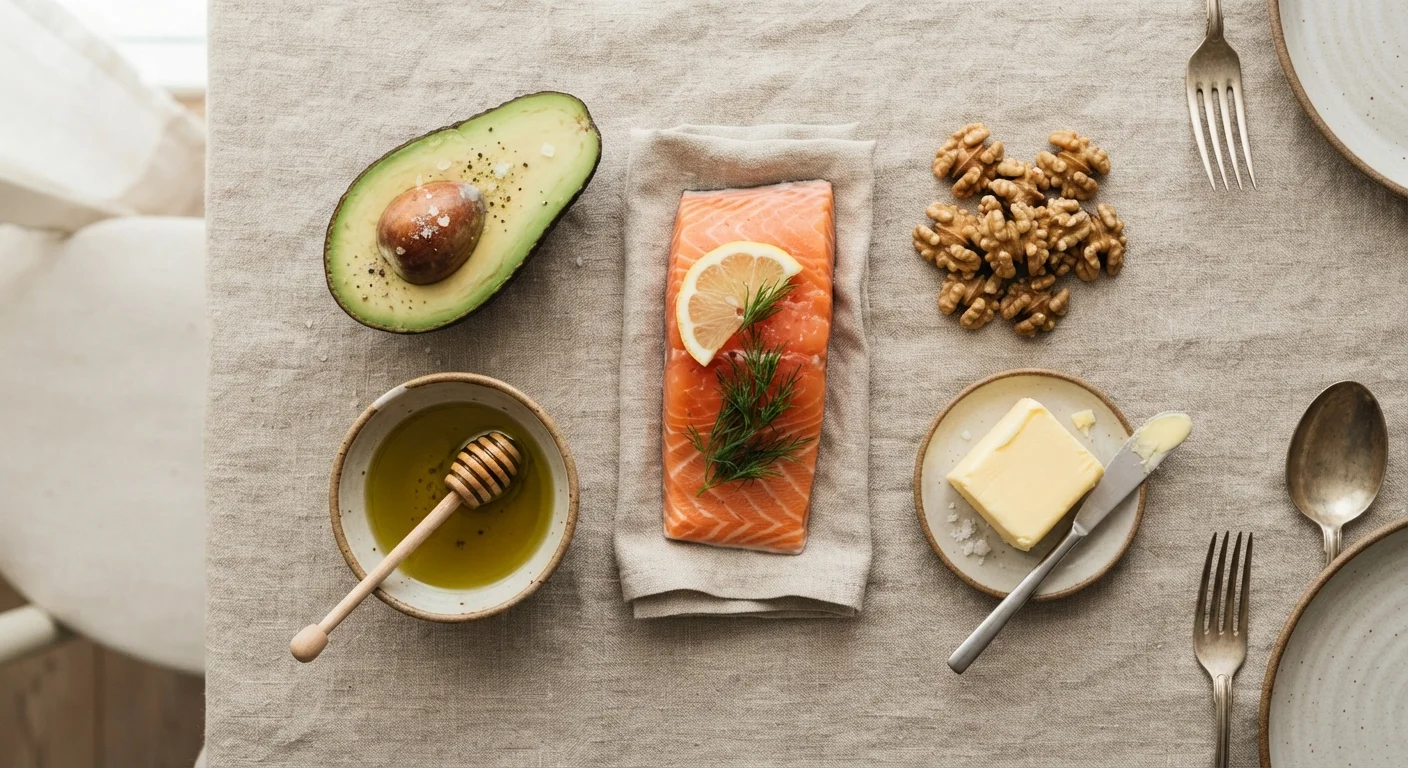
- Monounsaturated fats (MUFAs): Found in olive oil, avocados, and most nuts. Associated with improved LDL cholesterol levels and reduced inflammation in multiple population studies.
- Polyunsaturated fats (PUFAs): Includes omega-3 and omega-6 fatty acids. Omega-3s — found in fatty fish like salmon, as well as flaxseed and walnuts — are linked to heart and brain health benefits. Omega-6s are abundant in corn and soybean oils.
Swapping saturated fats for unsaturated ones is one of the most consistently supported dietary shifts in cardiovascular nutrition research. Common macronutrient myths often lump all fats together — the unsaturated/saturated distinction is exactly why that framing falls apart.
Trans Fats
Artificial trans fats — produced by partially hydrogenating vegetable oils — raise LDL cholesterol and lower HDL (high-density lipoprotein, the protective kind), a uniquely harmful combination. The U.S. Food and Drug Administration removed partially hydrogenated oils from its "generally recognized as safe" list, and most artificial trans fats have been phased out of the American food supply. Small amounts of naturally occurring trans fats exist in beef and dairy, but these appear to behave differently from their artificial counterparts in the body. Always check ingredient lists for "partially hydrogenated oil" as a signal of artificial trans fat presence.
Saturated Fat
A type of dietary fat whose carbon chains carry the maximum number of hydrogen atoms, resulting in no double bonds. Found mainly in animal products and some tropical oils; solid at room temperature.
Unsaturated Fat
A category of dietary fat containing one or more carbon double bonds. Liquid at room temperature and generally associated with favorable effects on cholesterol levels compared to saturated fat.
Trans Fat
A type of fat created when liquid vegetable oils are partially hydrogenated. Artificial trans fats raise harmful LDL cholesterol and lower protective HDL cholesterol, and have largely been removed from the U.S. food supply.
LDL Cholesterol
Low-density lipoprotein cholesterol, often called "bad" cholesterol. Elevated LDL levels are associated with increased cardiovascular disease risk.
Omega-3 Fatty Acids
A class of polyunsaturated fats essential to the body. Found in fatty fish, walnuts, and flaxseed; associated in research with heart and brain health benefits.
Partially Hydrogenated Oil
A processed oil created by adding hydrogen to liquid vegetable oil, producing artificial trans fats. Listed on ingredient labels and considered a marker of trans fat presence.
Putting It Into Practice
Understanding fat categories is most useful when it shapes everyday choices rather than fueling anxiety. A few grounded principles:
- Replace butter with olive oil in cooking where the flavor works.
- Choose fatty fish (salmon, sardines, mackerel) as a regular protein source for omega-3 intake.
- Read ingredient lists on packaged snacks and baked goods for partially hydrogenated oils.
- Nuts, seeds, and avocado are practical sources of unsaturated fat that fit into many eating patterns.
It's also worth noting that whole foods carry fat alongside fiber, protein, and micronutrients — context that matters. A handful of walnuts is metabolically different from walnut-flavored crackers, even if both list fat on the label. For more on navigating food labels and processing levels, see what food labels don't tell you about whole and processed foods. And to understand how your body actually uses fat for fuel, Fat as Fuel covers the underlying metabolic process.
This article is for general informational and educational purposes only and is not a substitute for professional medical or nutritional advice. Consult a qualified healthcare provider or registered dietitian for guidance tailored to your individual health needs.